The endotoxin line on a peptide COA reports bacterial endotoxin measured by an LAL or recombinant assay, in EU per mg of peptide, EU per vial, or EU per mL. Convert by multiplying EU/mg by the milligrams in the vial, then dividing by the mL of liquid. A "Pass" only means the result sits under whatever specification the lab or vendor chose. Pharmaceutical limits are built from a maximum human dose (K/M under USP <85>); a research reagent has no such dose, so the unit and the stated basis matter more than the verdict.
The endotoxin line on a peptide COA can be per milligram, per vial or per millilitre, and the "Pass" beside it depends on a specification the lab or vendor chose. Convert the result to one unit, find the stated basis, and judge the number rather than the word.
The confusion shows up in nearly every testing thread. On 6 October a buyer on r/PeptidePathways wrote that an AI tool called "0.5eu/mg" acceptable while their result read "5eu/mg", and that "anything under 350 per vial is passing". A reply asked: "Is that reading for EU for mg or the vial?" (thread). Both readings can be true at once; example 4 below shows how.
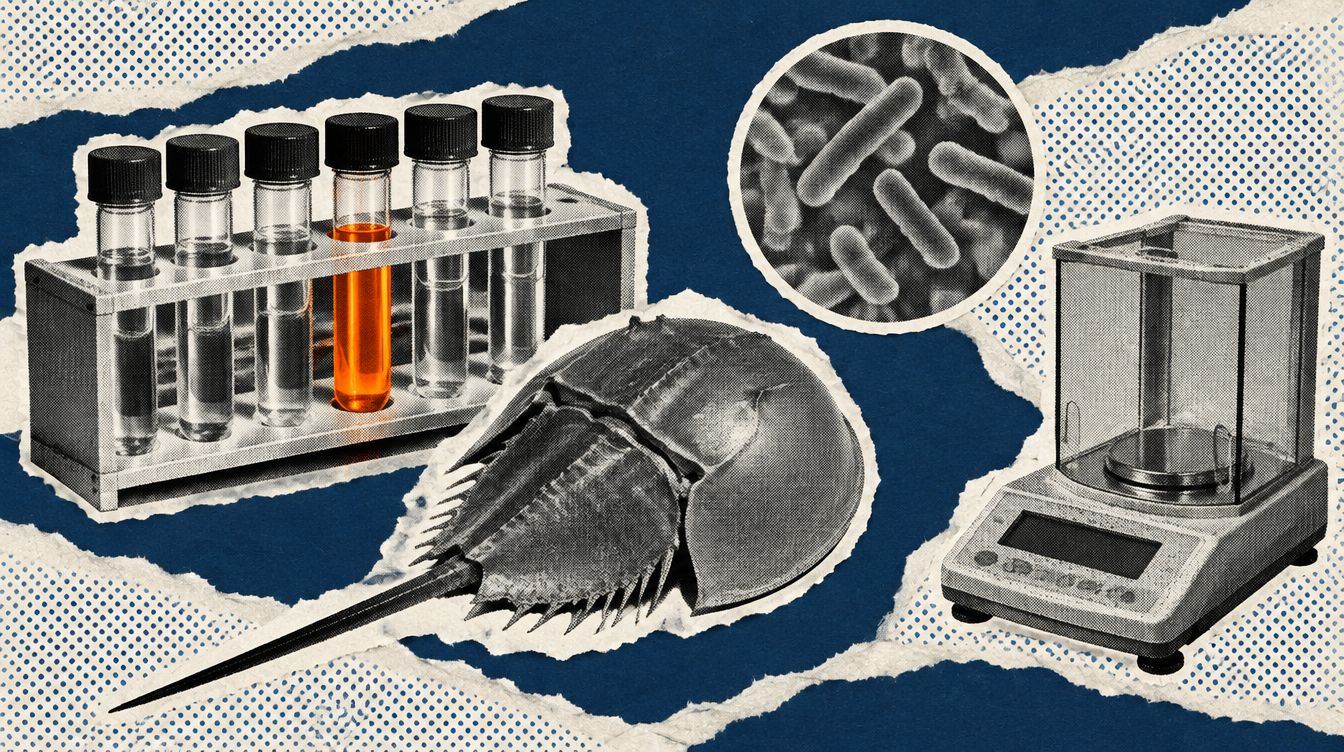
What does the endotoxin line on a peptide COA measure?
It measures lipopolysaccharide from the outer membrane of gram-negative bacteria. Labs use the Limulus amebocyte lysate (LAL) test, made from horseshoe crab blood, or recombinant reagents that do the same job without the crab. USP chapter <85> sets out the LAL methods (gel clot, turbidimetric, chromogenic) and USP <86> the recombinant ones. FDA reissued its endotoxin Q&A guidance in March 2026 and still points firms to USP <85> for methods and acceptance criteria.
Results come in endotoxin units (EU), calibrated against a USP reference standard. An EU measures biological activity, not weight, so a COA can only express it relative to something: a milligram of peptide, a vial, or a millilitre of liquid. The test does not detect live bacteria or fungi, and it says nothing about purity or identity. A vial can read 99.8% pure by HPLC and still carry a high endotoxin load, because endotoxin sits at nanogram amounts that HPLC purity methods do not see.
Is the reading EU per mg or per vial?
It depends on the lab, and some vendors restate the number in their own unit.
| Lab | Unit on the report | Source |
|---|---|---|
| Janoshik | EU per vial for lyophilised vials; EU per mL for liquids; reporting range 1 to 1,000 EU per vial | Janoshik endotoxin page, checked 9 Oct 2026 |
| Vanguard Laboratory | EU per mg | Hello Stacks vial certificates, read 9 Oct 2026 (our audit) |
| Bacteriostatic water, any lab | EU per mL | the USP water monographs use EU/mL |
The unit sits beside the number or in the method column. If it is missing, you cannot compare the result with anything; ask the lab, not the vendor.
How do you convert EU/mg, EU/vial and EU/mL?
Three formulas cover every case:
- EU per vial = EU/mg × mg of peptide in the vial
- EU per mg = EU per vial ÷ mg of peptide in the vial
- EU per mL = EU per vial ÷ mL of liquid after reconstitution
Use the measured content from the same certificate when it has one. Vials are often overfilled, so the label figure understates the total. The first two examples use real Vanguard results from our Hello Stacks audit; they show unit arithmetic only.
Example 1: thymosin alpha 1 at 18.50 EU/mg (10 mg label, 10.49 mg measured)
| Step | Calculation | Result |
|---|---|---|
| Per vial, label mass | 18.50 × 10 | 185 EU |
| Per vial, measured mass | 18.50 × 10.49 | 194 EU |
| Per mL in 2 mL of liquid | 194 ÷ 2 | 97 EU/mL (92.5 on label mass) |
Example 2: TB-500 at 11.8 EU/mg (10 mg label, 11.63 mg measured)
| Step | Calculation | Result |
|---|---|---|
| Per vial, label mass | 11.8 × 10 | 118 EU |
| Per vial, measured mass | 11.8 × 11.63 | 137 EU |
Example 3: a per-vial result converted back to per mg
| Step | Calculation | Result |
|---|---|---|
| Janoshik-style result | as reported | 12 EU per vial |
| Per mg on a 10 mg vial | 12 ÷ 10 | 1.2 EU/mg |
Example 4: the Reddit comparison (5 vs 0.5 EU/mg on a 10 mg vial)
| Reading | Per vial | Under a 350 EU-per-vial line? |
|---|---|---|
| 5 EU/mg | 5 × 10 = 50 EU | yes |
| 0.5 EU/mg | 0.5 × 10 = 5 EU | yes |
A per-vial cut-off and a per-mg cut-off only line up for one vial size. A fixed 350 EU per vial allows 35 EU/mg on a 10 mg vial and under 6 EU/mg on a 60 mg vial, so the same powder can pass in a small vial and fail in a large one.
Where do pharmaceutical endotoxin limits come from?
From a formula tied to a product's dose. FDA's 1985 inspection guide states it as K/M:
- K is 5.0 EU per kg of body weight, which FDA describes as the approximate threshold pyrogen dose for humans and rabbits (0.2 EU/kg for intrathecal products).
- M is the maximum dose per kg given in one hour, for that specific product.
FDA's worked example is cyanocobalamin injection: with M of 14.3 mcg/kg, the limit is 0.35 EU per mcg, or 350 EU per mL at 1,000 mcg/mL. A different dose gives a different limit.
Water has no dose cap, so USP gives it fixed limits: 0.25 EU/mL for Water for Injection and Sterile Water for Injection, and 0.5 EU/mL for Bacteriostatic Water for Injection. The Hello Stacks bac water report read "<0.5 EU/mL", which matches the monograph's own wording ("less than 0.5").
A research peptide has no approved dose, so it has no M and no derivable limit, and we do not supply one. A lab that prints a pass line for a research vial has picked a dose assumption to get there; find out which.
Why is a "less than" result different from "not detected"?
A "less than" result tells you the reporting limit; "not detected" alone does not. Each LAL run has a sensitivity (lambda, in EU/mL) and a dilution. Peptides, salts and acids can interfere with the reaction, so labs dilute until a spiked control recovers within the 50% to 200% range USP <85> requires. More dilution raises the lowest number they can report. USP caps it with the maximum valid dilution: the endotoxin limit times the sample concentration, divided by lambda.
| Result type | Example | What it tells you |
|---|---|---|
| A number | 11.8 EU/mg | measured within range |
| A ceiling | "<0.5 EU/mg", "<1 EU/vial" | below the reporting limit at that dilution; Janoshik's 1 EU-per-vial floor is 0.1 EU/mg on a 10 mg vial |
| "Not detected" or "Negative" with no limit | n/a | nothing about sensitivity; ask for the reporting limit |
Example 5: a high ceiling (LL-37, "<50.00" EU/mg, 5 mg label, 4.92 mg measured)
| Step | Calculation | Result |
|---|---|---|
| Highest value the ceiling allows, per vial | 50 × 4.92 | up to 246 EU |
| What it rules out | n/a | anything above 50 EU/mg |
| What it says below 50 EU/mg | n/a | nothing |
That line still says "Pass".
Can a lab's "Pass" mislead you?
Yes, when the specification is one you would not have chosen. Our Hello Stacks audit read 34 Vanguard Laboratory vial reports on 9 October 2026, and all four results in the table below are marked "Pass".
| Peptide | Result | Against 5 EU/mg (the Reddit figure) |
|---|---|---|
| Thymosin alpha 1 | 18.50 EU/mg | above |
| TB-500 | 11.8 EU/mg | above |
| Frag 176-191 | 8.86 EU/mg | above |
| LL-37 | "<50.00" EU/mg | cannot be placed |
The printed basis is "5 EU/kg (350 EU total for a 70 kg adult)": K multiplied by a 70 kg body weight, applied to the whole vial as if it were one hourly dose. Under that rule a 10 mg vial passes at up to 35 EU/mg. We do not call these results failures, because no agreed specification exists for a research reagent. We do note that the certificate prints a human-dose criterion for a product sold "for in-vitro research only", and that the A2LA accreditation scope we read for Vanguard does not list LAL endotoxin.
A "Pass" can also be the vendor's own label. If the certificate shows a number, convert the number and ignore the verdict. If it shows only "Pass", you have no result to check.
Is endotoxin the same as sterility?
No. A vial can clear one and fail the other.
| Sterility test | Endotoxin test | |
|---|---|---|
| Looks for | living bacteria and fungi | lipopolysaccharide from gram-negative cell walls |
| Method | culture, usually 14 days (USP <71>) | LAL or recombinant reagent, same week |
| Survives filtering and killing? | sterile filtering removes organisms | endotoxin can pass filters and stays active after bacteria die |
| Janoshik add-on price | $290, needs 2 unopened vials | $180, 1 vial (2 recommended) |
Sterile filtration and lethal heat remove live organisms but not reliably endotoxin. If a certificate lists one test, look for the other.
What does an endotoxin test cost?
| Lab | Price | Unit | Turnaround | Source and date |
|---|---|---|---|---|
| Janoshik | $180 add-on | EU per vial (1 to 1,000) | about 7 business days | lab page, 9 Oct 2026 |
| Finnrick | included in $249 Standard; custom add-on from $29 | not stated on the page | Standard targets 2 weeks | Finnrick endotoxins page, 9 Oct 2026 |
| Kovera Labs | $100 | not checked | not checked | Disclosed Labs directory (secondary) |
| BT Labs | $125 | not checked | not checked | a Reddit commenter, 6 Oct 2026 (secondary) |
Janoshik asks for a separate vial for endotoxin when possible, so plan for an extra vial if you are testing one lot. Our lab comparison covers full panels and turnaround at each lab.
How do you read the endotoxin line on a COA?
Work through it in this order:
- Find the unit. EU/mg, EU per vial or EU/mL. No unit, no comparison.
- Find the mass it refers to. Use the measured milligrams from the same report when you convert.
- Check for "<". A ceiling is a bound, not a value. Note how high it is.
- Read the method. LAL (gel clot, turbidimetric, chromogenic) or recombinant. "Endotoxin: Pass" with no method is not a result.
- Read the specification. Who set it, and on what basis. A body-weight figure such as "350 EU" is a human-dose assumption.
- Resolve the report on the lab's own site and match the lot to your vial. The steps for Janoshik are in how to verify a Janoshik COA.
- Compare like with like. Convert every result for the same peptide to one unit before ranking lots or vendors.
A COA without an endotoxin line tells you nothing either way. A 15 September thread in r/Peptidesource opened with "Vendor sent a COA with no endotoxin or sterility panel. Is that normal or should I be concerned?" (thread). It is common: none of the 116 public Janoshik retatrutide and tirzepatide reports in our 30 June 2026 snapshot included an endotoxin result (Janoshik tirzepatide and retatrutide results). Contamination is one of the failure modes in our vendor failure taxonomy.
What we read
FDA's 2026 endotoxin Q&A guidance and its bacterial endotoxins inspection guide. The USP Bacteriostatic Water for Injection monograph text. Janoshik's and Finnrick's endotoxin pages on 9 October 2026. The 34 Vanguard Laboratory reports behind our Hello Stacks audit and Vanguard's A2LA scope. Two Reddit threads on endotoxin units and missing panels. This is a document review; we did not run or commission an endotoxin test for this page.
What we did not read
The full text of USP <85>, <86> and <71>, which sit behind USP's subscription; we rely on FDA's summaries of the K/M formula and the water limits. Kovera's and BT Labs' own price lists. The method validation behind any lab's reporting limit.
Sources
- FDA, Pyrogen and Endotoxins Testing: Questions and Answers, Edition 2, March 2026
- FDA, inspection technical guide no. 40: bacterial endotoxins/pyrogens, 1985 (K/M formula, water limits)
- USP, Bacteriostatic Water for Injection monograph proposal noting USP <86>
- Janoshik, endotoxin analysis, checked 9 Oct 2026
- Finnrick, peptide endotoxins testing, checked 9 Oct 2026
- vialaudit, Hello Stacks audit, 9 Oct 2026
- r/PeptidePathways, endotoxin per mg vs per vial thread, 6 Oct 2026
- r/Peptidesource, COA with no endotoxin or sterility panel, 15 Sep 2026
Frequently asked
Is an endotoxin result on a COA per mg or per vial?
It depends on the lab. Janoshik reports lyophilised vials in EU per vial and liquids in EU per mL. Vanguard Laboratory reports in EU per mg, as seen on Hello Stacks certificates. Read the unit printed next to the number before comparing it with any limit or with another lab's result.
How do you convert EU/mg to EU per vial?
Multiply EU/mg by the milligrams of peptide in the vial. Use the measured content from the same certificate if it has one, not the label. A 10 mg vial at 18.50 EU/mg holds 185 EU. Divide by the millilitres of liquid to get EU/mL: 185 EU in 2 mL is 92.5 EU/mL.
What is an acceptable endotoxin level for a research peptide?
There is no official limit for a research reagent, and we do not set one. Pharmaceutical limits come from the K/M formula in USP <85>: 5 EU per kg of body weight divided by the maximum dose per kg per hour. Without an approved dose, no limit can be derived. Compare lots and labs in the same unit instead.
Why does my COA say "<0.5 EU/mg" instead of a number?
The result fell below the lowest amount the lab could report at the dilution it used. The figure after "<" is a ceiling, not a measurement. A low ceiling such as "<0.5" is informative; a high one such as "<50.00" tells you little. "Not detected" without a stated limit tells you less.
Is an endotoxin test the same as a sterility test?
No. A sterility test grows samples for about 14 days to find living bacteria or fungi. An endotoxin test measures a toxin from bacterial cell walls that stays active after the bacteria are dead or filtered out. A vial can pass sterility and still carry endotoxin.
How much does an endotoxin test cost?
Janoshik lists endotoxin analysis at $180 as an add-on, reported in EU per vial, about seven business days (checked 9 October 2026). Finnrick includes endotoxin in its $249 Standard test. Other labs' prices we have seen come from directories or buyers, not the labs' own pages.