What we read
Janoshik Analytical's public-tests database, Finnrick Analytics' published testing methodology and the headline figure of 7,164 tests across 205 vendors as of April 2026, Peptide Protocol Wiki's transparency critique of Finnrick's lab-assignment policy, and approximately 80 r/Peptides comments between January 2024 and April 2026 that referenced specific Janoshik COA results. This is a data synthesis, not a first-hand audit.
The 43% headline
The single most-cited industry statistic comes out of Janoshik's 2024 reporting: of all peptide samples submitted to Janoshik for HPLC purity quantification in 2024, 43% failed to meet the purity claim on the vial label. That number is the closest thing the grey-market peptide industry has to an FDA Form 483 — a measurable, repeatable indictment of label accuracy at scale.
It is also generous to the industry. The 43% includes only samples that vendors or community members chose to submit for testing — a self-selected pool that skews toward vendors confident enough to face independent verification, or toward batches a buyer specifically suspected. The unmeasured population (vendors that never submit, customers that never test) is almost certainly worse.
Where the gap concentrates
Three patterns dominate the failed-purity dataset.
1. Identity fraud, not just dilution. In 2025, Janoshik flagged that roughly 23% of retatrutide samples submitted for analysis contained exendin-4 analogs instead of authentic retatrutide. This is not a purity gap — the molecule itself is wrong. Exendin-4 is a related GLP-1 agonist that costs a vendor a fraction of what retatrutide costs to synthesize correctly. For the buyer, identity fraud is harder to detect than under-purity and impossible to verify without mass-spec.
2. Tier-correlated dishonesty. The samples failing badly cluster in a specific vendor band: small operators claiming 99%+ purity whose actual HPLC results came back at 71–91%. The vendors at the top of community lists rarely fail by more than 1–2 percentage points; the vendors at the bottom miss by 8–28 points and frequently flunk identity confirmation too. This pattern argues against the popular advice "any COA is enough." A COA from a low-tier vendor is more likely to be wrong than absent.
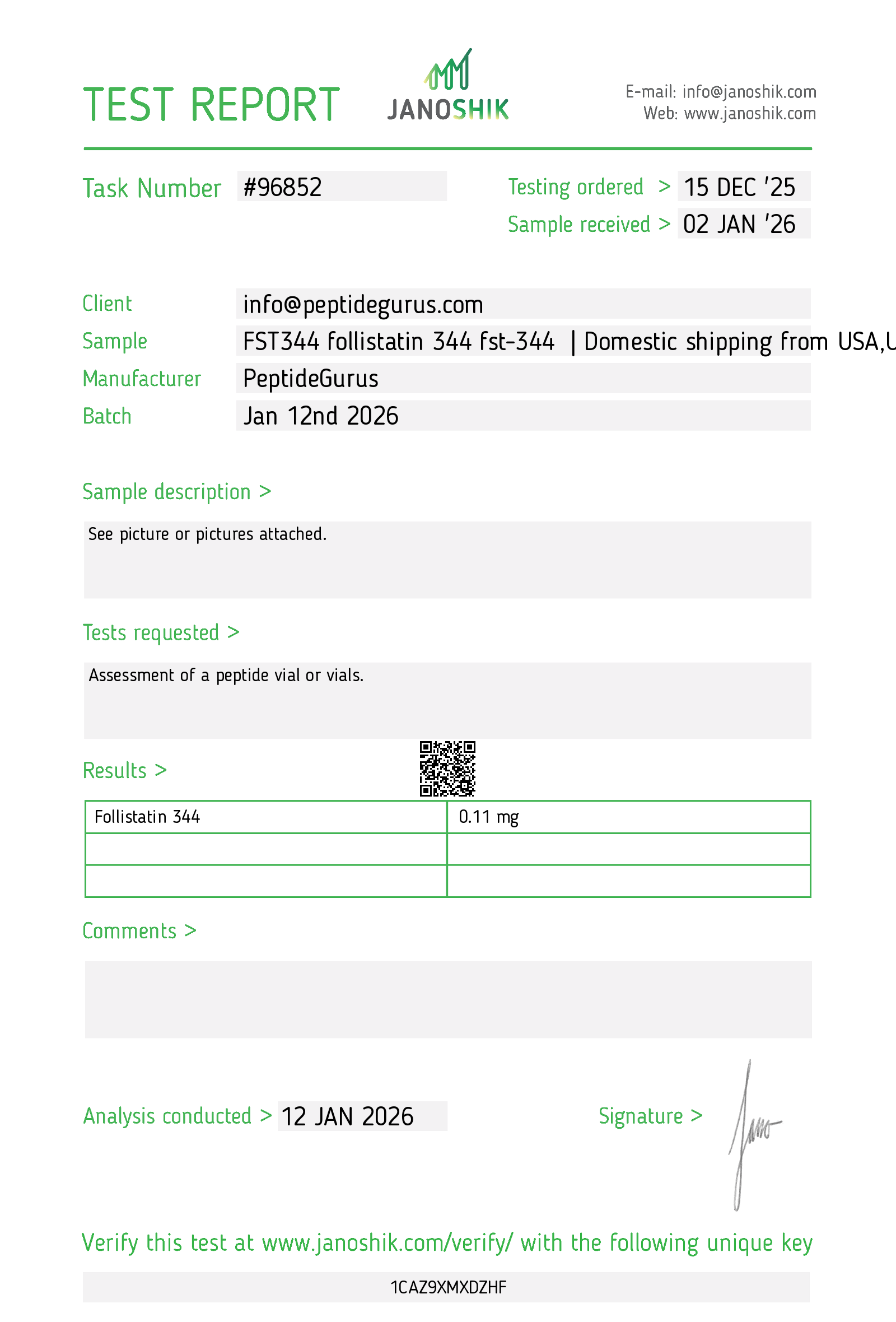
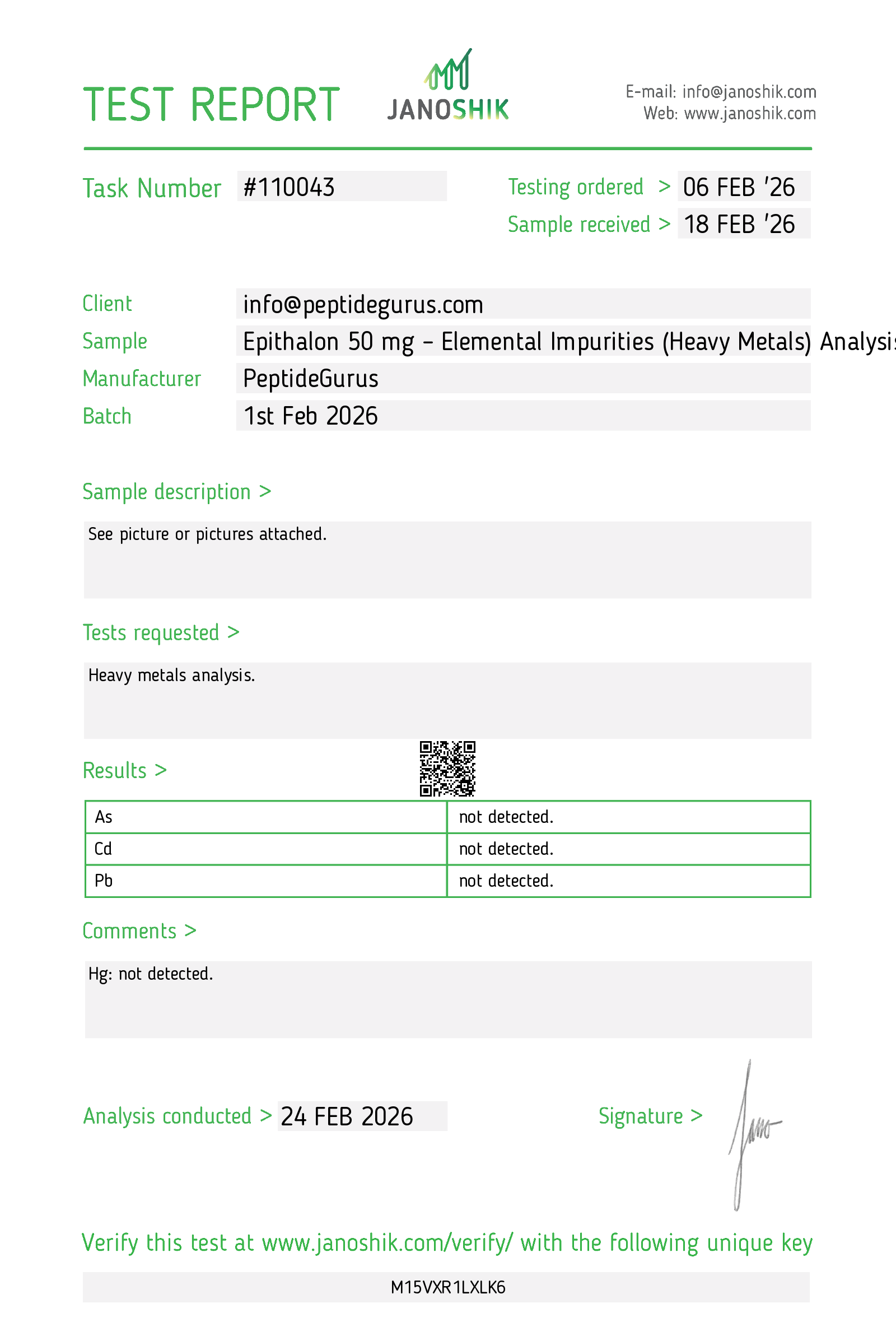
3. Generic-batch COAs. A persistent failure mode is the vendor that publishes one COA and reuses it across batches that share nothing but the SKU label. Janoshik's QR-verified COAs are designed to defeat this — the QR resolves to a specific vial test on Janoshik's servers, not a PDF a vendor can edit. Vendors publishing non-Janoshik COAs without batch IDs or lot numbers are particularly suspect.
What the data does not show
Two limitations worth surfacing before drawing conclusions.
Self-selection bias. Janoshik tests what is sent to them. A vendor that refuses to submit batches to independent testing — or only submits favorable batches — does not appear in the failure rate. The 43% may be a floor.
Lab-assignment opacity in adjacent databases. Peptide Protocol Wiki has documented transparency concerns at Finnrick specifically: no published methodology for assigning samples to labs, no public handling of inter-lab discrepancies, no way to verify whether all results from a vendor's submissions are published. Finnrick's 7,164-test figure remains the largest dataset in the space, but its handling of adverse results is not auditable in the way Janoshik's QR-verified public-tests database is.
What our local mirror shows — 200 publicly-submitted tests
In May 2026 we mirrored 200 tests from Janoshik's public database into a local audit corpus and extracted the headline fields from every report image. The aggregate numbers from that subset:
- Median purity: 99.7% across the 143 tests with a quantified figure.
- Mean purity: 99.5%. Range: 95.2% – 100.0%.
- Pass rate: 99.5% on tests with an explicit pass/fail marker (149 of 150 confirmed-pass; 1 explicit failure; 49 reports without an explicit pass/fail field).
- Identity confirmations: 195 of 200, with 5 reports flagged for identity-confirmation issues.
The headline number — 99.7% median purity on the publicly-submitted pool — is the self-selection bias quantified. It is not a refutation of the 43% industry figure; it is the other side of it. Vendors submit batches they expect to pass; the failures we'd most like to see are the ones withheld from publication. Our local audit corpus and Finnrick's 43% number are measuring different populations. Both are right.
Compound mix in the public corpus
The 200 tests cluster heavily on the GLP-1 mainstream:
| Compound | n | Median purity |
|---|---|---|
| Retatrutide | 44 | 99.8% |
| Tirzepatide | 33 | 99.8% |
| GHK-Cu | 12 | 99.4% |
| BPC-157 + TB-500 blend | 10 | — (blend) |
| Tesamorelin | 7 | 99.6% |
| BPC-157 | 5 | 99.8% |
| MOTS-C | 5 | 99.4% |
| hGH | 6 | 96.2% |
Two observations on this distribution:
Retatrutide is the most-tested compound. This matches the demand pattern we documented in our FDA peptide enforcement timeline: retatrutide is the highest-margin, most-margin-sensitive SKU in the niche, and vendors have a strong incentive to publish clean COAs for it specifically.
hGH is the only compound where the public median falls below 99% in our subset (n=6, median 96.2%). hGH is also the compound class with the most disclosed sterility caveats in the report bodies. If this pattern holds at larger n, it is a material finding for buyers — but n=6 is too thin to assert it as more than a directional signal.
Where the public submitters ship from
Across the 200 tests, agent-extracted shipping origin distribution:
- US: 55 tests
- EU: 43 tests
- UK: 31 tests
- Canada: 4 tests
- China: 1 test
Many vendors ship from multiple regions — the 134-test total above exceeds 200 because individual tests carry multi-region warehouses. The takeaway: the publicly-tested submitter pool is overwhelmingly US/EU/UK domestic, not Chinese-origin. The China-resold market that exists alongside Janoshik's public submissions is largely not in this dataset, which is itself a selection-bias finding.
What our local mirror cannot tell us
The 200 tests in our extracted corpus represent what Janoshik exposes publicly today; the full Janoshik database is larger, and Finnrick's adjacent dataset is larger still. We did not extract from the verify URLs Janoshik 302s to a navigation page (older test IDs, ~31 of them); those reports are not retrievable from the public web. We also did not find any of the eight vendors we maintain audit profiles for in this submitter pool — Limitless Life, Particle, Ascension, Pure Rawz, Swiss Chems, and the three shutdown vendors all source through manufacturers or operate without submitting to Janoshik's public listing under a vendor-recognizable identifier.
This is the most important caveat for any reader of vialaudit specifically: our vendor profiles do not yet have direct Janoshik public-test data. The first-hand audit cycle is the only way to add it.
What this means for buyers
Three operating rules consistent with the data:
- Treat the COA as binary on identity, gradient on purity. A vendor that cannot produce mass-spec identity confirmation should be skipped without further analysis. A vendor with HPLC purity 1–2 points below claim is acceptable; 5+ points below is a vendor we would not buy from.
- Match the COA to a batch. A COA without a batch number, lot ID, or date matching your specific vial is not a COA — it is a marketing PDF.
- Prefer Janoshik QR over vendor-stated COAs when both are available. The QR resolves to a record outside the vendor's control.
We use a 1.5-percentage-point cross-lab tolerance on every audit on this site. Vendors whose batch COA differs from independent retesting by more than that figure get the gap surfaced in the audit notes and weighted into the COA-quality subscore.
What we did not read
This synthesis does not include private-lab results that vendors share only with verified buyers; communications on Discord servers behind invite-only walls; or non-English forums (r/Peptides, Peptide Protocol Wiki, and Janoshik's database are predominantly English-language). The next iteration of this analysis will incorporate the German-language harm-reduction forums where some retatrutide identity-fraud cases were first surfaced.
Related reading
- How to verify a Janoshik COA — the verification step that turns a published purity number into something a buyer can trust.
- Is Janoshik testing legit? — the methodological backstop for using any of these numbers.
- How peptide vendors fail: a taxonomy — the eight failure modes that produce most of the 43% gap.
- Vendor-level Janoshik leaderboards for Retatrutide, Tirzepatide, and BPC-157.