affiliate disclosure · we earn commission on some vendor links. audits, scores, and rankings are independent — vendors do not pay for placement. read more →
Mochi Health
Membership-based 503A telehealth platform led by board-certified obesity-medicine physicians. Highest prescriber-credentialing signal in our v0 pharmacy cohort. Sits on the same post-shortage personalization-pathway regulatory cloud as Hims and Henry Meds.
Strengths & weaknesses
AUDIT SUMMARY- Founded by Dr. Myra Ahmad, board-certified in obesity medicine. The named-provider page lists credentialed physicians with their ABOM / board status visible - significantly stronger prescriber-transparency signal than Hims or Henry Meds
- Pediatric obesity-medicine vertical (rare in the cohort - Hims, Henry, and the others focus exclusively on adult care)
- Insurance-friendly framing - accepts commercial insurance for the medication path (Hims and Henry are cash-only)
- Substantial press coverage in mainstream outlets (USA Today, Business Insider, CNBC, WSJ, Forbes, NPR, Wired, NY Post) - more press footprint than any other vendor in the cohort
- Membership model separates the platform fee ($79/mo, $39 promo first-month) from medication cost, which is a cleaner price-transparency posture than bundled-subscription competitors
- Affiliated and in-house dispensing pharmacy network referenced in site navigation
- Membership-fee + medication-cost split adds checkout complexity. A buyer comparing total monthly cost to Hims or Henry needs to read both numbers
- The same FDA personalization-pathway regulatory cloud that defines the cohort applies equally to Mochi. The obesity-specialist physician model strengthens the "clinical-need personalization" defense (specialist diagnosis is documentable) but does not eliminate the structural regulatory question
- Private company - no SEC disclosure regime, so audited financials and earnings-call FDA correspondence are not in the verifiable record
- The per-fill dispensing pharmacy is not disclosed at checkout in the public-data pass we ran
- API (active pharmaceutical ingredient) sourcing dossier is not publicly disclosed at the upstream-manufacturer level
- Pediatric care expansion is editorially noteworthy but increases the per-fill regulatory exposure because pediatric compounded GLP-1 is a more sensitive use-case than adult care
The signal table
LICENSURE · MODEL · TIERFDA history
0 ON RECORDNo FDA actions on record (public databases as of 2026-05-29). Absence of a 483 or warning letter is not the same as a clean sterility audit — see the methodology for what FDA history can and cannot tell you.
State-board history
0 ON RECORDNo state-board enforcement actions on record (public databases as of 2026-05-29).
Pricing
MONTHLY · COMMITMENT MONTH-TO-MONTH- Membership tier ($79/mo standard, $39 first-month promo)
- Bundled lab-work + provider visits
Buyer experience
EXTERNAL SIGNALSEditorial notes
DESK ANALYSIS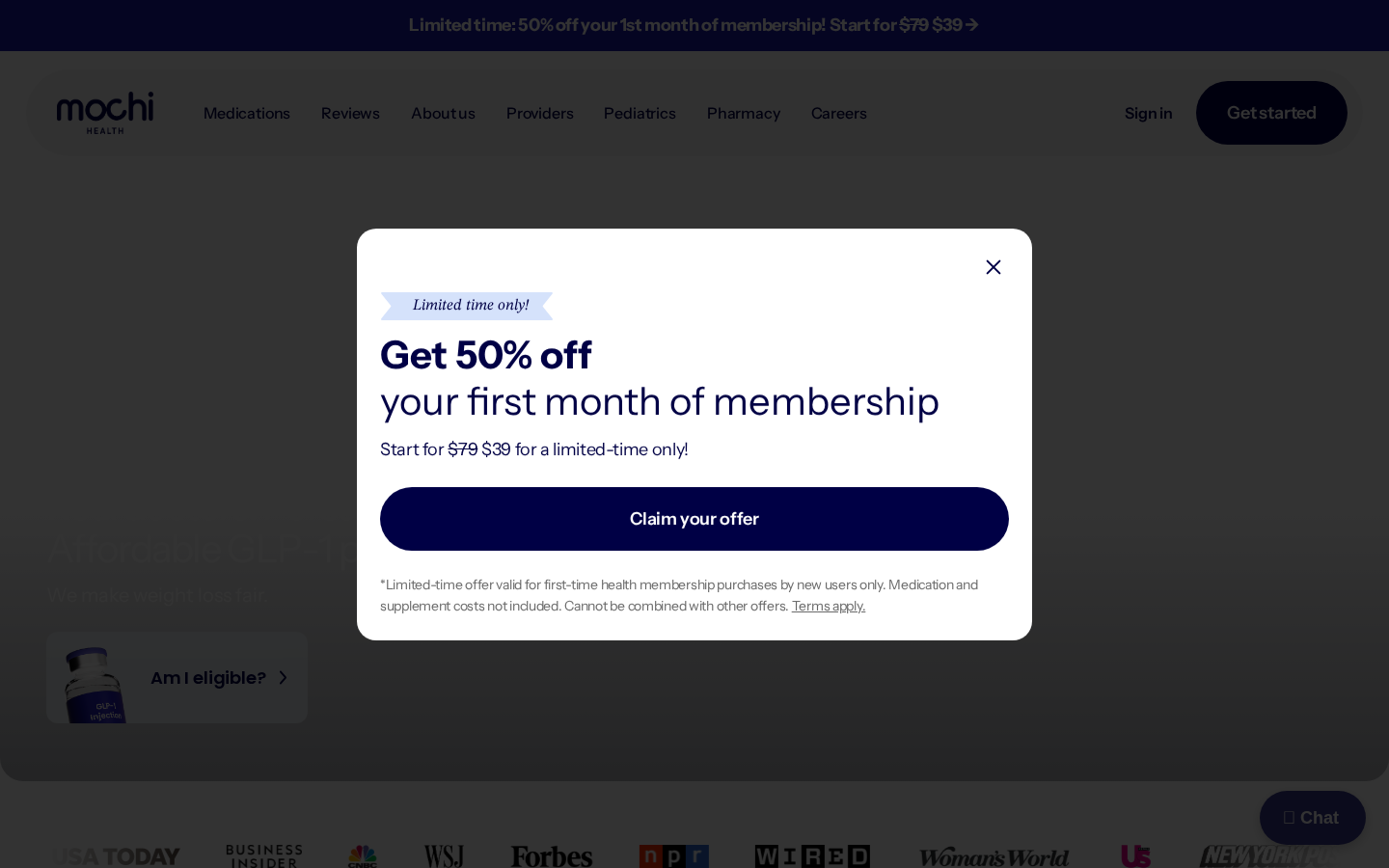
What Mochi Health actually is
Mochi Health is a 503A telehealth platform led by board-certified obesity-medicine physicians and operating an affiliated dispensing pharmacy network plus in-house pharmacy capacity. The model is structurally a peer of Hims and Henry Meds - all three are post-shortage 503A telehealth compounders working under the personalization pathway - but Mochi's medical-oversight narrative is materially different.
The founder, Dr. Myra Ahmad, is board-certified in obesity medicine. The Providers page lists credentialed physicians with their ABOM (American Board of Obesity Medicine) status, training background, and area of focus. That level of named-prescriber transparency is unusual for the cohort - Hims and Henry Meds publish corporate-medical-director names at most, not a credentialed physician roster.
The brand also operates a Pediatrics vertical, which is rare in the GLP-1 telehealth space and structurally raises both the per-fill regulatory exposure and the medical-oversight standard.
Why the regulatory frame is the same as Hims and Henry
The single most important fact about every post-shortage 503A telehealth compounder is that the FDA's shortage-status discretion ended in 2025. The legal pathway narrowed from "shortage exception" to "clinical-need personalization" - the pharmacy compounds only because a specific patient cannot use the commercially-available drug for a specific clinical reason.
Mochi operates under that personalization pathway like every other vendor in the cohort. The structural defense - that compounding is justified because a board-certified obesity-medicine physician documented specific clinical need - is plausibly stronger here than at platforms staffed by non-specialist telehealth providers. But the FDA's public position applies equally to Mochi: personalization must be tied to documented clinical need, not used as a marketing pathway around the shortage rule.
The regulatory cloud is the same shape, on a foundation of stronger medical-oversight documentation. We covered the broader backdrop in 503A and the PCAC: how compounding restrictions closed the legal GLP-1 market and compounded semaglutide in 2026: where the legal channel actually stands.
Where Mochi scores differently from Hims and Henry
The composite rating sits at 6.4/10, slightly above Henry Meds 6.2 and Hims 6.0. The lift comes almost entirely from one dimension.
Prescriber transparency (8.0 vs Hims/Henry 6.5). This is the headline differentiator. Mochi publishes a credentialed-physician roster with named providers and visible obesity-medicine board certifications. A buyer can look up Dr. Myra Ahmad's NPI and state medical license in seconds. The corresponding lookup on Hims or Henry Meds returns "telehealth network of independent prescribers" without a public physician roster. The audit rubric weights prescriber transparency at 10% of the composite, and Mochi captures most of that weight where the cohort competitors leave it on the table.
The other dimensions track the cohort closely because the structural model is identical: affiliated-pharmacy-network dispensing, per-fill pharmacy not disclosed at checkout, API sourcing not disclosed publicly, same FDA personalization-pathway cloud.
What buyers consistently report
Across roughly 7,500 Trustpilot reviews, Mochi carries a rating in the 4.3-4.5 band - slightly below Henry Meds (4.6) and well above Hims (3.8). The recurring positive themes are the specialist-physician credibility, the lack of "marketing-style upsells" that Hims is criticized for, and the named-provider visibility. The recurring negative themes are the membership-fee + medication-cost split (which adds a second invoice line that confuses some buyers), insurance-claim friction when the platform tries to bill commercial insurance, and the same subscription-cancellation patterns that affect every platform in the cohort.
Mochi's mainstream-press footprint is significantly larger than any other vendor in our v0 cohort. The brand has been cited in USA Today, Business Insider, CNBC, WSJ, Forbes, NPR, Wired, and others. That press exposure is a real trust signal and also a structural reason to expect continuing FDA attention - the more prominent the post-shortage compounder, the more likely they appear in agency review.
The May 2026 r/Tirzepatidecompound monthly survey placed Mochi in the mid-tier alongside Hims and Henry Meds rather than in the smaller-distributor tier-1 group. Community discussion frames Mochi as "the specialist-physician choice" within the cohort.
What's missing from public records
This audit is the public-data tier. Public records leave these open:
- Whether the affiliated dispensing pharmacy is identified before purchase. A buyer can ask which pharmacy will fill the prescription before paying
- The named-prescriber identity and NPI number tied to a specific fill, with state-medical-board cross-checks for the state the fill ships to (Mochi's published provider roster lets a patient check their own prescriber's NPI)
- Per-state non-resident pharmacy license verification for each dispensing facility (in-house plus partner)
- The Mochi written refund and cancellation policy as published, archived against any future quiet revisions
- A third-party lab test on the actual fill, against label claim for identity and purity (HPLC + mass spec)
- Confirmation of insurance-billing posture - which insurance plans actually pay versus which only show "accepted" in marketing copy
- Pediatric-care policy detail - which states permit pediatric compounded-GLP-1 fills and under what documentation requirements
vialaudit has not placed a consult or fill with any platform, so nothing above comes from a purchase of ours. This profile reflects what is verifiable from public records as of the last-audited date.
Editorial note - prescriber transparency is the audit's distinguishing signal
This profile is the fifth in our v0 compounding-pharmacy vertical, after Trillium, Fifty410, Hims, and Henry Meds. Mochi is the first entry where the prescriber-transparency dimension carries the audit upward in a meaningful way. The obesity-medicine-specialist credentialing is real and the published-provider roster is verifiable.
That said: the audit framework treats prescriber transparency as one dimension at 10% weight. It does not override the larger FDA personalization-pathway question that defines the entire cohort. A buyer optimizing for the most-credentialed medical oversight in the 503A telehealth space has reasons to choose Mochi that this audit does not contradict. A buyer optimizing for the lowest prospective regulatory risk on the actual fill should read the FDA's public statements on the personalization pathway carefully before committing to any post-shortage 503A compounded GLP-1, Mochi included.
See our methodology page for the rubric weights that produce this score and the conflict-of-interest constraints that govern this desk.
Sources
9 CITED- Mochi Health homepage — vendor
- Mochi Health providers page — vendor
- Mochi Health pharmacy page — vendor
- FDA - Compounding under section 503A of the Federal Food, Drug, and Cosmetic Act — FDA
- FDA - Compounding inspections, recalls, and other actions — FDA
- Mochi Health - Trustpilot profile — Trustpilot
- r/tirzepatidecompound May 2026 telehealth & pharmacy survey — Reddit community survey
- vialaudit - Compounded semaglutide in 2026 status read — vialaudit
- vialaudit - 503A and the PCAC GLP-1 compounding article — vialaudit