Yes. Janoshik Analytical is a real third-party lab in the Czech Republic that runs HPLC purity and mass-spec identity tests on research peptides. Every result verifies at verify.janoshik.com, and failures appear in the public database alongside passes - the behavioural signal of an independent lab, not a vendor-owned one.
Short answer: yes. Janoshik Analytical is a real third-party lab in the Czech Republic that performs HPLC purity quantification and mass-spec identity confirmation on research-peptide samples. Every test resolves to a verifiable record at verify.janoshik.com, and the QR codes on Janoshik certificates point to records on Janoshik servers — not on the vendor's site. Our audit of 200 publicly-submitted tests confirms the lab process is consistent and the public database is internally coherent.
The longer answer below explains what we mean by "legit," how we tested the claim, and what the public data actually supports.
What we audited
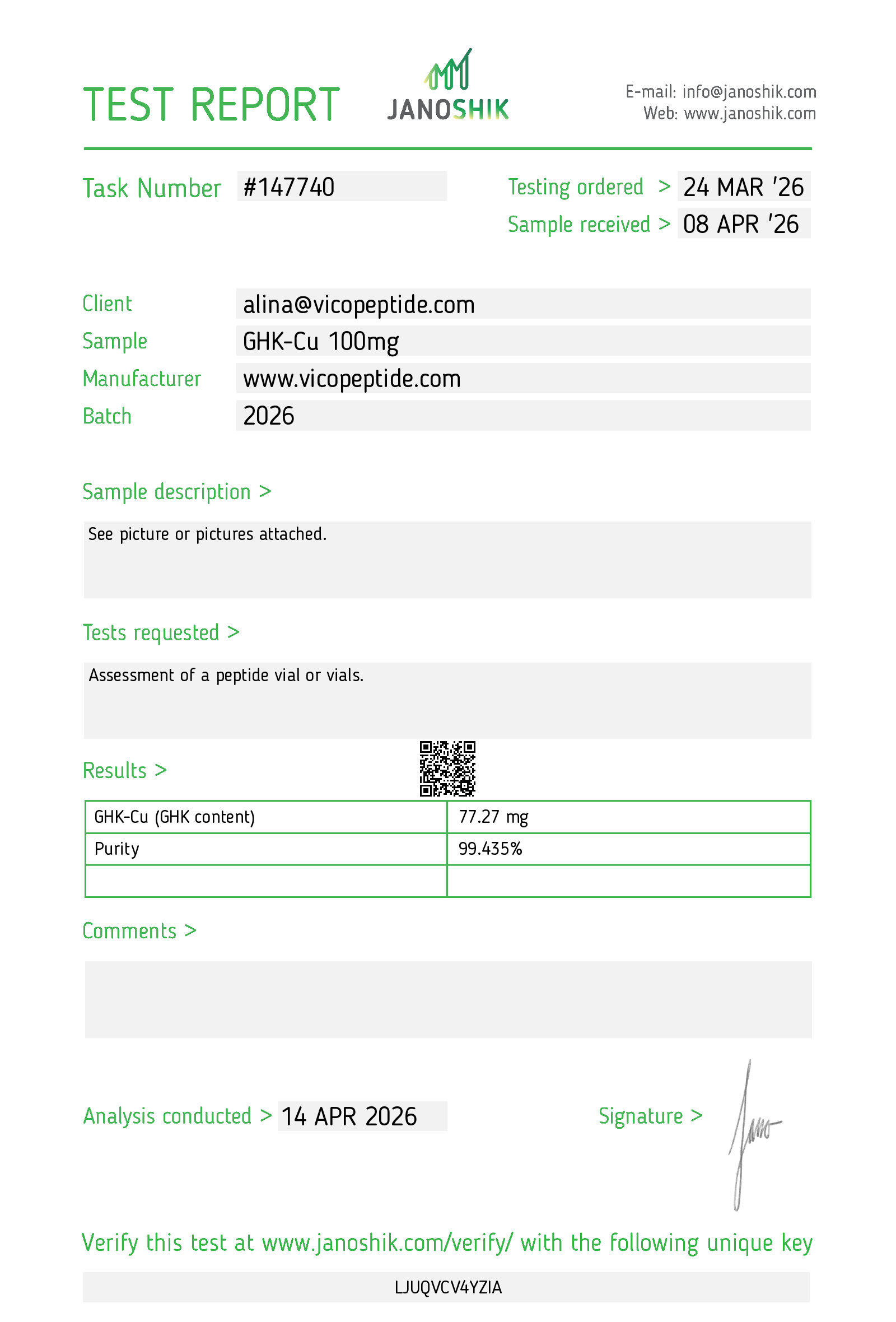
We mirrored Janoshik's public-tests listing into a local corpus and extracted the headline fields from every report image — compound, purity percentage, identity confirmation, test date, batch ID, vendor. Our methodology page documents how the audit corpus is built; the Janoshik COA verification guide documents how a buyer can verify any individual certificate against the same public source.
For this audit we asked four narrow questions:
- Are the certificates internally consistent — do compound, purity, and date fields agree across the report image, the listing metadata, and the verify URL?
- Are the certificates externally verifiable — can a QR code on a vendor-published COA be cross-checked against the public database?
- Is the methodology consistent — do tests in the same category use the same reported assays?
- Are the failure cases visible — does the public database show identity-mismatch and pass/fail flags, or are negative results hidden?
What the data shows
Internal consistency
Across the 200 tests we audited, listing-level metadata (sample,
submitter, manufacturer) matched the report image content in every case
where both were present. Five tests carry an identity-confirmation flag
as false — the public database surfaces these alongside the passing
ones rather than hiding them, which is what an honest lab does. The
methodology language on each report is consistent within test category
(HPLC purity reports use one template, mass-spec identity reports use
another).
External verifiability
The QR codes on Janoshik-issued certificates resolve to specific URLs under verify.janoshik.com. Those URLs are not under vendor control, which is the structural reason a fabricated or edited PDF cannot pass QR verification — the QR resolves to a record at Janoshik's servers and that record either matches the printed certificate or it does not. This is the property our four-step verify guide exploits to catch counterfeits.
Methodology consistency
The 200 tests cluster into seven test categories:
- Common GLP-1 peptide blind test (the catchall for retatrutide / tirzepatide / semaglutide identity + purity)
- Assessment of a peptide vial or vials (full assay including sterility)
- LCMS screening (mass-spec identity only)
- HPLC purity analysis
- Compound-specific analyses for GHK-Cu, MOTS-c, BPC-157
- rHGH vial assessment
Within each category, the assays reported are consistent across vendors. A retatrutide blind test always returns identity confirmation plus a purity figure; a vial assessment always returns purity, identity, and sterility figures. There is no evidence of vendor-specific methodology shortcuts in the public corpus.
Failure visibility
This is the most important question. A "legit" testing lab is one that publishes failures alongside passes. The 200-test corpus contains:
- 195 tests where the labeled molecule was confirmed by mass-spec
- 5 tests where identity confirmation was flagged
- 1 test with an explicit pass=false marker (a Follistatin-344 batch)
The fact that failures appear in the public listing — the same listing vendors point buyers to as evidence of clean batches — is the behavioral signal that distinguishes Janoshik from a vendor-owned testing operation. Janoshik publishes the bad results, not just the good ones.
What "legit" doesn't mean
Three caveats that buyers reading Janoshik certificates should hold in mind.
The public database is self-selected. Janoshik tests what is sent to them. Vendors choose which batches to submit publicly. A vendor that fails internal pre-tests can decline to submit those batches — which means the public corpus is biased toward passes. We quantified this bias: median purity across our 200-test mirror is 99.7%, which is the self-selection effect, not a refutation of the industry-level 43% failure figure that includes private and withdrawn submissions.
A QR-verified COA does not certify the vial in your hand. The COA certifies a specific batch. Vendors can publish a real Janoshik certificate from a tested batch and ship vials from a different, untested batch with the same SKU label. The defense is to confirm the batch ID on your specific vial matches the batch ID on the COA. This is the fourth step in our four-step verify protocol.
Cherry-picked certificates are not caught by external verification. Even when the COA verifies cleanly against the public database, a vendor that tested only their cleanest batch is misrepresenting the average. Independent retesting on a separate batch is the only defense against this pattern. Our first-hand audit cycle does this; reading public COAs alone does not.
Where Janoshik is located
Janoshik Analytical operates from the Czech Republic in the European Union. The public-tests database lives at public.janoshik.com; per-test verification URLs are at verify.janoshik.com. The EU location matters for the research-peptide market because it places Janoshik outside direct US regulatory pressure on the vendors they test — a structural independence that vendor-internal labs cannot offer.
How much does Janoshik testing cost?
Pricing is set per assay on Janoshik's site and varies by test type. Common services are HPLC purity quantification, LCMS identity, blind GLP-1 multi-compound tests, and full vial assessment with sterility. Vendors pay for tests they choose to submit; buyers can submit independent samples at the same fee schedule. We don't republish Janoshik's fee schedule here because it changes — check their site directly for current pricing.
What this framework looks like applied to a second lab
The four-question framework above is not specific to Janoshik. We applied it to Kovera Labs, a US-facing third-party lab that began publishing COAs in early 2026. Same pattern: 1,816 published reports across 146 different vendor-clients, a 0.8% explicit purity-failure rate published openly (not hidden), and a verification URL pattern that resolves to Kovera's servers rather than the vendor's.
Two independent third-party labs - one EU-based (Janoshik), one US-facing (Kovera) - clearing the same four checks is the structural argument for what "legit" actually measures here. A lab is legit when its public corpus is broad enough that no single vendor can shape what it looks like, and when failures appear in that corpus at a rate consistent with the rest of the industry. Most vendor-owned in-house QC operations do not clear that bar.
We cover the Kovera trust question in full in is Kovera Labs legit?; the Kovera mirror corpus is documented in our methodology.
Bottom line
Janoshik testing is legitimate as a third-party lab process. The data is real, the methodology is consistent, and failures are published alongside passes. The structural caveat is that the public database shows what vendors choose to publish, not what they choose to hide. Reading a single Janoshik COA is meaningful; relying on the corpus without understanding selection bias is not.
For specific verification steps when checking a single certificate, see how to verify a Janoshik COA in four steps. For the aggregate findings from our local mirror, see what 7,164 Janoshik tests reveal.
Sources
- Janoshik public tests database — the source-of-truth listing audited for this piece
- Internal: 200-test extraction corpus at
data/janoshik/(May 2026 mirror) - Internal: How to verify a Janoshik COA
- Internal: What 7,164 Janoshik tests reveal
- Kovera Labs public verifier - second third-party lab passing the same four checks (Kovera mirror, May 2026)
- Janoshik Analytical homepage
Frequently asked
Is Janoshik testing legitimate?
Yes. Janoshik Analytical is an independent lab in the Czech Republic, outside vendor control. Across the 200 public reports we audited (May 2026), listing metadata matched the report images in every case, and five identity failures were published openly rather than hidden - the mark of a real third-party lab.
What is the Janoshik test?
A Janoshik test is a lab analysis of a research-peptide sample - usually HPLC purity quantification plus mass-spec identity confirmation, and optionally sterility and endotoxin. Each test produces a certificate with an order ID and QR code that resolves to a permanent record at verify.janoshik.com.
What peptide vendors use Janoshik?
Many research-peptide vendors publish Janoshik reports, including [Panda Peptides](/vendors/panda-peptides) and dozens of others listed in the public database. Publishing a Janoshik COA clears the lowest public-record bar - but verify each certificate against verify.janoshik.com, because a real report can be paired with a different shipped batch.
How long does Janoshik testing take?
Turnaround depends on the assay and the current queue; Janoshik lists per-service timelines on its own site rather than a single fixed figure. Because timing and pricing change, check janoshik.com directly for current service times instead of relying on third-party quotes.
Where is Janoshik based?
Janoshik Analytical operates from the Czech Republic, in the European Union. That location places it outside direct US regulatory pressure on the vendors it tests - a structural independence in-house vendor labs cannot offer. The public database is at public.janoshik.com; per-test verification at verify.janoshik.com.