A cloudy reconstituted peptide vial usually means one of three things: protein aggregation (often reversible by warming to room temperature), solvent-induced precipitation (the diluent or storage conditions destabilized the peptide), or microbial contamination (visible turbidity plus haze that doesn't clear on warming). Aggregation is recoverable. Contamination is not. The diagnostic is whether the cloudiness clears when the vial reaches room temperature and is gently swirled.
Three causes of cloudy peptide vials
A reconstituted peptide vial that turns cloudy looks the same regardless of cause, but the underlying chemistry splits into three categories.
Aggregation is the peptide molecules clustering into small visible groups while still chemically intact. Driven by temperature, agitation, and peptide-specific hydrophobic interaction surfaces — cold storage is the most common trigger. Usually reversible: warm the vial, swirl gently, the haze clears.
Precipitation is the peptide falling out of solution permanently. The dose-volume math breaks because the molecule is no longer uniformly distributed. Triggered by pH excursion, ionic strength, freeze-thaw damage, or peptide-diluent incompatibility. Does not clear on warming.
Microbial contamination is bacterial or fungal growth in the vial. Rare with bacteriostatic-water reconstitution (the benzyl alcohol inhibits growth) but possible with sterile-water reconstitution past 24 hours or compromised seals. Presents as turbidity with particles, color shift, or surface film.
Aggregation is recoverable, precipitation is not, contamination is a sterility failure. The diagnostic that distinguishes them is straightforward.
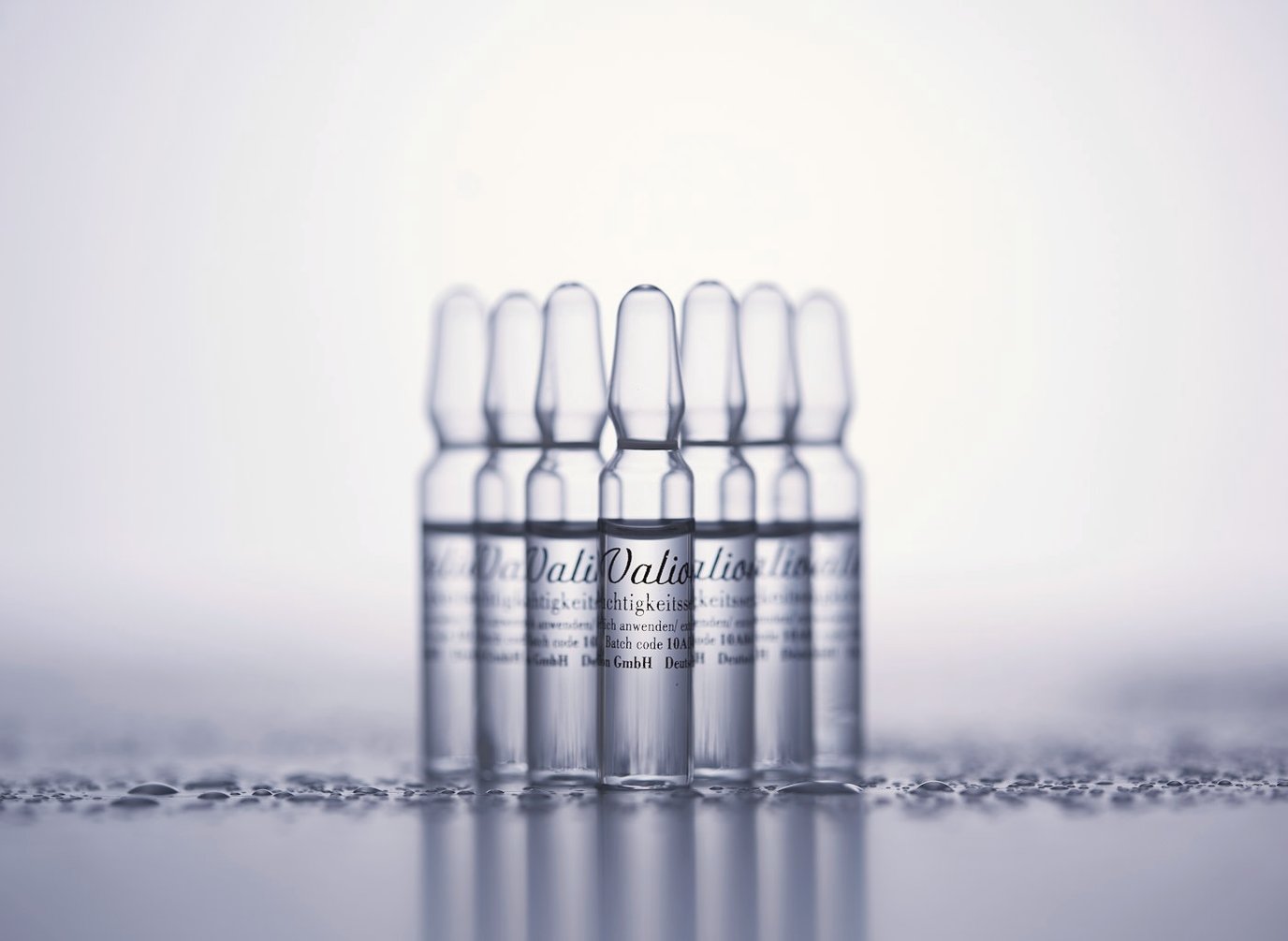
How to tell them apart
The diagnostic takes 30 minutes and a clean working surface.
- Bring to room temperature. 20-30 minutes on the counter, out of direct sunlight. Passive warming only — no hot water bath, no warming in your hand.
- Inspect under bright neutral light. A desk lamp against a white background works. Note: uniform haze, localized turbidity, particles, color shift, surface film.
- Swirl gently. Rotate the vial by the cap for 30-60 seconds. Do not shake — shear drives more aggregation and can denature the peptide.
- Inspect again. Compare to the pre-swirl state.
Results map to causes:
- Haze cleared or substantially reduced → aggregation. The vial behaves as a research reagent at the original concentration. Most common for GLP-1 class peptides at fridge temperature.
- Haze persists, uniform, no particles, no color change → solvent-induced precipitation. Dose-volume math is unreliable.
- Localized turbidity, particles, color shift, or surface film → contamination. Sterility failure.
The diagnostic is imperfect — you can't fully separate precipitation from contamination without analytical chemistry — but conservative enough for research-protocol purposes: anything that doesn't clear on warm-and-swirl is a discard candidate.
Which peptides are most prone to clouding
Retatrutide. The r/Peptides thread "Reta Gone Cloudy After 2 Days in fridge" (55 comments) catalogs the pattern: vials reconstituted to spec develop visible haze within 1-3 days of fridge storage, then re-clear on warming. The triple-agonist structure (GLP-1, GIP, glucagon binding regions) gives retatrutide three distinct hydrophobic interaction surfaces — the proposed mechanism for its aggregation prominence relative to mono- and dual-agonist GLP-1s. See the retatrutide reconstitution guide for dose-math context.
Tirzepatide on freeze-thaw. Tirzepatide tolerates fridge storage well but is freeze-thaw sensitive. One controlled freeze-thaw cycle per aliquot is usually fine; multiple cycles produce persistent haze that is precipitation, not aggregation.
GHRH analogs at room temperature. Tesamorelin, CJC-1295, and sermorelin cloud when stored at room temperature or repeatedly cycled between fridge and counter. Refrigerated storage and minimal temperature cycling reduces the prevalence.
BPC-157 and TB-500 are less prone to visible aggregation under normal research-protocol storage. Cloudiness in these compounds more often signals a contamination event or a non-compendial diluent.
When to discard
Concrete rules for research-protocol vial assessment:
- Discard if haze persists after 30 minutes at room temperature and gentle swirling.
- Discard if visible particles are present at any point.
- Discard on color shift from the post-reconstitution baseline (yellow, brown, pink — anything other than clear).
- Discard if a visible film forms at the liquid-air interface.
- Discard on any off-odor beyond the faint benzyl-alcohol scent of BAC water — off-odors indicate contamination or peptide degradation.
- Discard if the rubber stopper shows damage, coring, or has been punctured more than 20-30 times. Seal integrity is the line between sterile and contaminated.
Aggregation that clears on warming is research-protocol usable. For everything else, discard rather than draw against an unknown concentration.
How to prevent it next time
Most cloudiness events trace to one of four upstream choices.
Reconstitution technique. Inject BAC water down the inside wall of the vial, not directly onto the peptide cake. Let the diluent contact the peptide passively for 1-2 minutes before any swirling. Do not shake — shaking introduces shear that drives agitation-induced aggregation. See the reconstitution guide for the full protocol.
Refrigeration discipline. Store at 2-8°C, light-protected, on a stable shelf — not the door, where temperature cycles on every open. Avoid repeated room-temperature excursions.
Single-dose aliquots for longer storage. Past 14-30 days, aliquot into single-dose sterile vials and freeze each. Trades one controlled freeze-thaw cycle per aliquot (well-tolerated by most peptides) against the slow degradation of an extended fridge-stored multi-dose vial.
BAC water choice. Bacteriostatic water is the default because the benzyl alcohol covers the multi-day reconstituted window. For benzyl-alcohol-sensitive peptides (some GHRH analogs), sterile water for injection is the alternative — same-day use only. See the BAC water 2026 vendor map.
What the literature says about peptide stability
The peer-reviewed stability literature on lyophilized peptides reconstituted in bacteriostatic water reports a consistent pattern.
Manning, Chou, Murphy, et al. (2010) Pharmaceutical Research identifies temperature, agitation, and pH excursion as the three primary drivers of visible aggregation. Mechanism: non-covalent self-association at hydrophobic interaction surfaces, generally reversible until precipitation thresholds are crossed.
Wang (1999) International Journal of Pharmaceutics distinguishes physical instability (aggregation, precipitation, denaturation) from chemical instability (deamidation, oxidation, hydrolysis). Only the physical pathway produces visible cloudiness.
Frokjaer and Otzen (2005) Nature Reviews Drug Discovery documents that peptide aggregation follows a nucleation-then-growth pattern — first detectable haze precedes a faster precipitation phase. That's the basis for treating any persistent haze as a discard signal rather than waiting to see if precipitation follows.
These are class-level studies. The retatrutide-specific evidence is the community-documented reversible-aggregation pattern above.
Related reading
- Peptide reconstitution guide — the full BAC water, syringe, and dose-math reference.
- Retatrutide reconstitution — the dose math for the three vial sizes most vendors stock.
- How to verify a Janoshik COA — the analytical step that distinguishes legitimate from suspect peptide product before reconstitution even begins.
- Bacteriostatic water in 2026 — current vendor map for the diluent.
Frequently asked
Why did my retatrutide vial go cloudy after a few days in the fridge?
Retatrutide is a large triple-receptor peptide with three hydrophobic interaction surfaces (GLP-1, GIP, glucagon binding regions). Cold storage slows molecular motion enough that aggregation-prone regions cluster — the visible effect is haze that forms in the fridge but clears on warming. The r/Peptides thread "Reta Gone Cloudy After 2 Days in fridge" (55 comments) documents the same pattern repeatedly: refrigerated reta clouds, then re-clears when the vial reaches room temperature. If your vial follows that pattern it is class-typical aggregation. If it stays cloudy on warming, the issue is something else.
Is a cloudy peptide vial dangerous?
It depends on which of the three causes is producing the haze. Reversible aggregation (clears on warming and gentle swirl) is harmless to the peptide identity — it is a physical state, not chemical degradation. Precipitation (the peptide has fallen out of solution and won't redissolve) means the dose-volume calculation is no longer valid because peptide is no longer uniformly distributed in the diluent. Contamination (microbial growth) is a sterility failure and the vial should be discarded. Without testing you cannot distinguish all three with certainty; the visual diagnostic gets you most of the way.
How do I tell if cloudiness is aggregation or contamination?
Bring the vial to room temperature (20-30 minutes on the counter, out of direct sunlight). Swirl gently — do not shake. Inspect against a bright neutral background. Aggregation-driven haze clears or substantially reduces during this process. Contamination-driven turbidity does not clear; it often appears as a denser, more localized cloudiness, sometimes with visible particles or a film at the liquid-air interface. Color shift (yellow, brown, pink) is a strong contamination signal. Persistent uniform haze that doesn't clear on warming is precipitation; localized turbidity with particles is contamination.
Can I still use a peptide vial that's slightly cloudy?
This is a research-protocol question, not a use question. If the haze fully clears on warming and gentle swirling, the vial behaves as a reconstituted research reagent at the original concentration. If the haze does not clear, the dose-volume calculation is no longer reliable because peptide concentration in solution is no longer uniform. The literature on peptide aggregation treats persistent visible haze as a discard indicator for research-protocol purposes — the analytical answer is to discard rather than dose against an unknown concentration.
What temperature should I store reconstituted peptides at?
2-8°C (standard refrigerator) is the typical research-protocol storage condition, protected from light, in the original vial. The 14-30 day stability window most peptide stability studies cite assumes this temperature range. Room-temperature storage accelerates degradation for most lyophilized-then-reconstituted peptides. Freezer storage is only appropriate for single-dose aliquots intended for one freeze-thaw cycle each — repeated freeze-thaw cycles destroy most peptides regardless of class.
Does bacteriostatic water vs sterile water affect cloudiness?
Both can produce cloudiness, but the failure modes differ. Bacteriostatic water (0.9% benzyl alcohol) inhibits microbial growth, so contamination-driven turbidity is less common in BAC-water-reconstituted vials than in sterile-water vials used past 24 hours. The benzyl alcohol can however accelerate solvent-induced precipitation for a small subset of peptides that are benzyl-alcohol-sensitive (some GHRH analogs are documented as such). Sterile water without preservative produces cleaner reconstitution for those compounds but only for same-day use.