Peptides from China are being stopped at the US border more often. CBP told the Wall Street Journal it made more than 2,400 seizures of noncompliant or fraudulent drug products, over 130,000 vials, from October 2025 to the end of August 2026. If your parcel is held you will usually get a written notice, and you can respond, but refused drugs worth $2,500 or less can be destroyed. A "US warehouse" changes where the parcel enters the post, not who made the powder.
If customs stops a peptide parcel from China, you will usually get a letter. FDA can destroy a refused drug worth $2,500 or less without offering to send it back, and a CBP seizure notice gives you 30 days to petition. Seizures are not rare: CBP told the Wall Street Journal of more than 2,400 seizures of noncompliant or fraudulent drug products, over 130,000 vials, from October 2025 to the end of August 2026. A "US warehouse" vendor moves where the parcel enters the post. It does not change who made the powder.
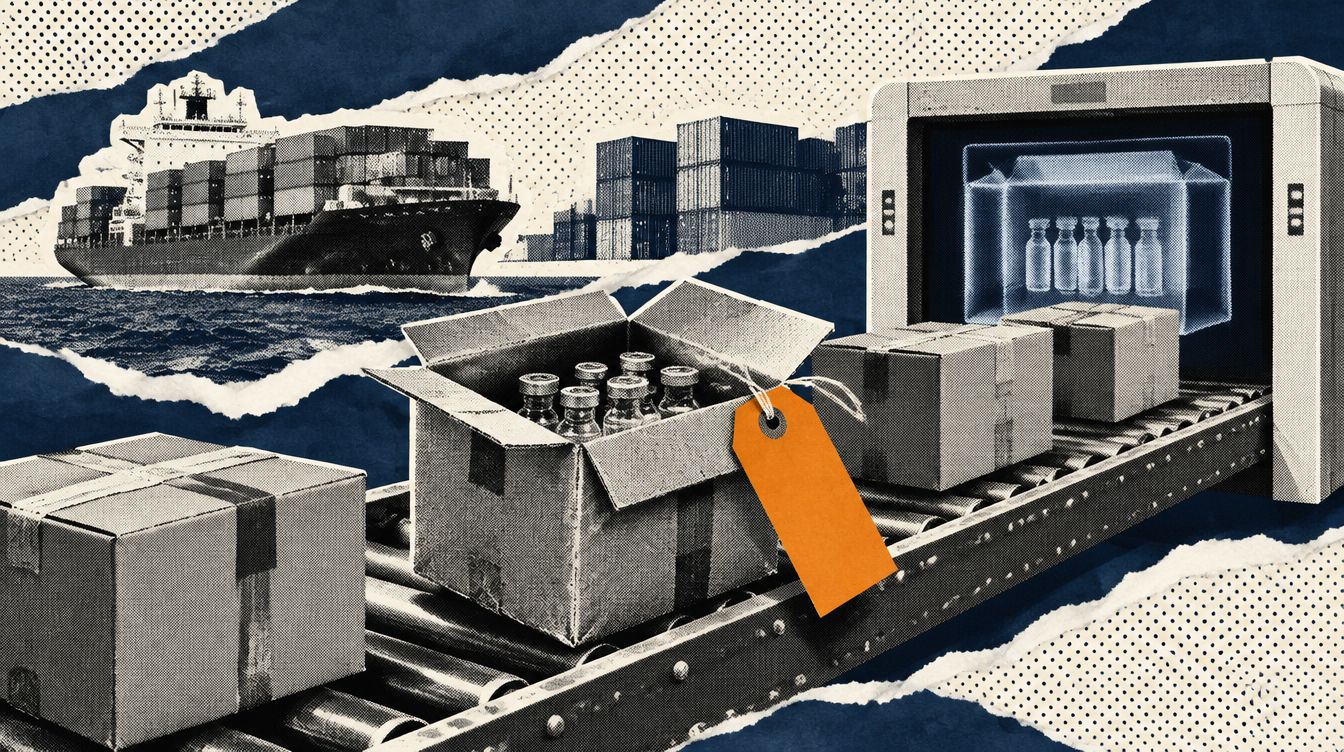
What happens when customs seizes your peptide package?
Two agencies can act on an imported parcel, and the paperwork differs. We cannot tell you in advance which one will handle yours, and neither publishes a peptide-specific rule.
If FDA holds it:
- FDA sends a Notice of FDA Action stating why the product appears violative and naming a contact. For mail, FDA generally treats the addressee as the owner.
- Under 21 CFR 1.94 you get a set period to send testimony, by email or phone, on why the product should be released.
- If FDA refuses a drug valued at $2,500 or less, it can destroy it without offering export.
- If you do not respond, FDA processes the parcel for destruction.
If CBP seizes it:
- CBP sends a notice of seizure.
- Under 19 CFR 171.2 a petition for relief is due within 30 days of the notice's mailing date.
- Under 19 CFR 171.1(d), a false statement in a petition can be prosecuted under 18 U.S.C. 1001.
For you as a buyer, that means reading the notice, noting the deadline and either answering it truthfully or letting it pass, knowing you will lose the parcel. Buyers online describe both kinds of letter; we have not seen one.
Global Entry. A 40-comment r/Peptidesource thread asked whether a seized parcel could cost someone Global Entry. Under 8 CFR 235.12, CBP may remove a member it finds "in violation of any customs, immigration, or agriculture regulations, procedures, or laws," at its sole discretion, with written notice. CBP's denial page describes how to ask for reconsideration. No public data show how often a seized peptide parcel leads to removal, and the Reddit replies (rare, or it happened to a friend) are unverified.
Several replies in that thread suggested ways to keep a parcel from being traced to the buyer. We do not repeat them. A false name or another person's address does not make an import lawful.
How many peptide parcels is customs seizing?
CBP has published one local figure and gave the WSJ one national figure.
On 31 March 2026, CBP Cincinnati said it had found more than 300 "master carton" shipments from a shipper in China since December 2025. Each large box hid about 15 pre-labelled parcels, around 5,000 in total, mis-declared as other goods. Seized compounds included retatrutide, semaglutide, tirzepatide, MOTS-C, semax and cagrilintide. By the WSJ's October count, Cincinnati had stopped roughly 400 cartons and nearly 6,000 parcels.
Nationally, CBP told the WSJ there were more than 2,400 seizures of noncompliant or fraudulent drug products, involving more than 130,000 vials, from October 2025 to the end of August 2026. That figure covers all illicit pharmaceuticals, not only peptides. CBP has not published a peptide-only breakdown that we could find.
The master cartons matter for the warehouse question. The WSJ notes that buyers on the receiving end "may not know their peptides originate from China." A domestic tracking number shows where the parcel was posted, nothing more.
What changed for peptides from China in October 2026?
Three things landed within three weeks. On 17 September, 20 state attorneys general wrote to Secretary of State Marco Rubio asking how the National Security Council could treat Chinese GLP-1 ingredients as a national-security threat. On 19 September, FDA added a Chinese peptide ingredient maker to its import red list. On 6 October, the Wall Street Journal and TRM Labs tied peptide sales to Chinese fentanyl-precursor makers.
Buyers noticed the border first. On 8 October a 130-comment r/Biohacking thread opened with "Has anyone had shipments siezed by customs recently?" One commenter wrote that the vendor said "the first AND second shipment have been siezed". Another claimed "Chinese logistics companies are starting to avoid shipping peptides". We could not confirm either claim.
What did the WSJ and TRM Labs report?
TRM Labs, a blockchain analytics firm, published on 6 October 2026:
- It has identified 150+ Chinese chemical makers that take crypto. About 75% list both fentanyl precursors and peptides. TRM calls that a lower bound.
- Crypto inflows to makers confirmed to sell both rose from $28.2M (2023) to $33.8M (2024) to $37.3M (2025), about 32% in two years. Most payments moved to USDT on TRON.
- Where buyer location could be traced, the US sent about 57% of value, Australia 25% and Thailand 10%. Most payments could not be placed.
TRM states the limit plainly: "It is not possible to quantify what share of crypto inflows is associated with which products." The $37.3M is not a peptide figure.
The Wall Street Journal ran the story the same day (we read the full syndicated text). It names Anhui Rencheng Technology, indicted by DOJ in 2023, as listing Melanotan II and semaglutide next to fentanyl-class chemicals. It reports that Anhui Ruihan Technology, also indicted in 2023, advertised retatrutide on a chemical marketplace, citing an ad TRM supplied. It also quotes Chainalysis that crypto peptide purchases now pass $10 million a month. The WSJ gives a different TRM count from the blog: more than 200 companies that have sold fentanyl precursors, of which at least 50 now sell peptides.
None of this shows that the vial in your drawer came from one of those firms. It shows the supplier pool includes them, and a storefront rarely names its supplier.
Which Chinese firms did FDA put on import alerts?
Import Alert 66-40 is FDA's list of foreign plants whose drugs can be detained without examination for failing good manufacturing practice. We read the red list on 10 October 2026 (alert revised 1 October):
| Date added | Firm | City |
|---|---|---|
| 19 Sep 2026 | Chengdu Shengnuo Biopharm Co., Ltd. | Chengdu |
| 21 Sep 2026 | Sanrace Biotechnology Co., Ltd. | Jinhua |
| 30 Sep 2026 | Shenzhen Benliju Bio-Tech Co., Ltd. | Shenzhen |
| 1 Oct 2026 | Nanjing Chengong Pharmaceutical Co., Ltd. | Nanjing |
Only Shengnuo is a known peptide maker. Its parent, listed in Shanghai, told investors that FDA inspected the plant in August, issued eight observations, and that the unit would halt all peptide ingredient sales to the US until the alert lifts (company notice, 23 September). The FDA entry covers all drugs from the plant, not only peptides. The other three listings do not say which products triggered them, so we do not read them as peptide actions.
A possible fifth Chinese entry is unclear. Guangdong Bangze Medicine carries a firm date of 7 August, but every product line under it is dated 28 September. The page does not say whether that is a new listing, so we leave it out of the table, and we have seen nothing tying it to peptides.
Import alerts work on factories FDA can register and inspect. Shengnuo files drug master files with FDA, according to Chinese trade press, so drugmakers can reference its ingredients. A crypto-only chemical seller that ships finished vials in master cartons sits outside that system, and an import alert is unlikely to name it.
The other list is Import Alert 66-80, the "Green List" of GLP-1 ingredient makers whose shipments are not detained. The 20-state letter cites FDA's May 2026 warning letter to Harbin Jixianglong Biotech, a Green List firm. According to the attorneys general, FDA found that the firm bought semaglutide from an unregistered plant and relabelled it as its own. The letter also cites Axios's July report on fentanyl-precursor makers moving into peptides. It concerns compounding ingredients, not research vials, but the problem is the one you face as a buyer: a label that names the seller, not the maker.
Is a "US warehouse" vendor different from a Chinese one?
The top-voted reply in the Global Entry thread was "Order from a vendor that have a us warehouse". Another reply described the options better: "CN vendors with US warehouses (fairly priced, often crypto only, delivery within 1-5 days)". Buyers in that thread mostly understood a warehouse vendor as the same Chinese seller with stock already inside the country. According to the WSJ, Anhui Rencheng, the indicted firm in its story, advertises warehouses in the US, Mexico, Canada and Germany.
Three setups go by the same label:
- US reseller. A US business buys finished vials, often from China, and ships them under its own brand.
- Chinese vendor with US stock. The seller imports in bulk and posts orders domestically.
- Reshipper or group buy. One US person receives a bulk parcel and re-posts single orders.
In all three someone imports, and the import faces the same FDA and CBP rules. What differs is whose name is on it and how many vials it holds. From outside, you can check some things and not others:
| Public signal | What it can show | What it cannot show |
|---|---|---|
| Ship time of 1 to 5 days | Stock sits in the US | Where the powder was made |
| First tracking scan at a US post office | Parcel posted domestically | Whether it arrived in a master carton |
| "Ships from USA" on the site | The seller's claim | Anything, until a parcel confirms it |
| Crypto-only checkout | No card processor would take the seller | The seller's location |
| Lab record naming a client | Who paid for that test | Who made the batch |
| Same lab record on two brands | One batch behind two storefronts | Which brand is the importer |
| Shared DNS, tag IDs or mail servers | One operator behind several brands | Where that operator buys |
The last two rows are where we have done the work. In our shared-COA analysis, one Janoshik test URL appeared on a US storefront and on a community tracker for an upstream manufacturer's batches. Our 32-domain alias scan found a US-branded peptide site sharing nameservers and mail servers with a second brand. Why vendors run alias clusters covers the reasons. None of those checks tells you which factory filled the vial, for any vendor on this site, US or not.
What do public lab records say about origin?
We keep a mirror of Janoshik's public test listing. It indexes 364 tests, 337 of them readable reports, crawled between 4 May and 30 June 2026. We counted which of the 364 listings carry any shipping-region text:
- 272 of 364 (74.7%) name no region at all.
- 72 mention the EU, 55 the US, 39 the UK, 19 "international" and 3 Canada. A report can name more than one.
- 1 names China.
- 48 (13.2%) list a client trading as a "Ltd", "Wholesale" or "OEM" business.
One China mention in 364 does not mean little product comes from China; TRM says "most of the powder" in this market is made there. It means the record almost never says. Region text is whatever the client typed, and the lab does not verify it. A report proves what was in the tested sample, not where it was made.
The Paradigm Peptides case showed how far "made in the USA" claims can drift from the truth: prosecutors said the products were imported from China, India and elsewhere.
What should you check before trusting an origin claim?
- Ask what the lab record proves. Resolve the test on the lab's own site and match the lot on your vial. The Janoshik verification guide shows how. That is evidence about the batch, wherever it came from.
- Read "US warehouse" as a shipping claim. It tells you about delivery time. It says nothing about who made the powder.
- Search the vendor in FDA's warning-letter database and in the enforcement cases we track in FDA and Lilly's August actions.
- Notice the payment rail. Crypto-only checkout removes chargebacks. TRM reports that most payments to the Chinese makers it tracks now go through USDT on TRON.
- If a parcel is stopped, answer the notice truthfully by its deadline or accept that you will lose it. The steps above set out both agencies' processes.
For retatrutide in particular, the legal routes and seller status are in how to get retatrutide in 2026.
What we read
The TRM Labs report of 6 October 2026 in full. The Wall Street Journal report of 6 October through a full syndicated copy, and the WSJ podcast summary. CBP Cincinnati's 31 March release. FDA Import Alert 66-40's red list as of 10 October and the 66-80 page. FDA's administrative-destruction page and the 2015 and 2024 Federal Register rules. 19 CFR Part 171, 8 CFR 235.12 and CBP's trusted-traveler denial page. The 17 September attorneys general letter. Shengnuo's 23 September exchange notice as printed in the China Securities Journal. Two Reddit threads of 8 October (130 and 40 comments). Our own mirror of Janoshik's public listing (337 readable reports, 364 indexed).
What we did not read
The WSJ article on wsj.com behind its paywall. TRM's underlying dataset. The Chainalysis report the WSJ cites. FDA's Harbin Jixianglong warning letter itself (we rely on the attorneys general's account). The FDA Form 483 issued to Shengnuo. Any CBP or FDA notice sent to an individual buyer. We placed no orders for this piece and did not test any vial.
Sources
- TRM Labs, Americans are buying peptides from the same Chinese chemical vendors selling fentanyl precursors, 6 Oct 2026
- The Wall Street Journal, Chinese makers of fentanyl ingredients now sell bootleg peptides to Americans, 6 Oct 2026 (read via syndicated copy, 7 Oct 2026)
- CBP, Cincinnati CBP foils scheme to smuggle over 5,000 unapproved peptides, 31 Mar 2026
- FDA, Import Alert 66-40 red list, revised 1 Oct 2026, read 10 Oct 2026
- FDA, Import Alert 66-80 (GLP-1 bulk drug substances)
- FDA, Administrative destruction authority
- Federal Register, Administrative destruction of certain drugs refused admission, final rule, 15 Sep 2015
- Federal Register, Administrative destruction, final rule, 31 May 2024
- eCFR, 19 CFR Part 171, fines, penalties and forfeitures
- 8 CFR 235.12, Global Entry program
- CBP, Trusted Traveler Program denials
- Attorneys General of Alabama and 19 other states, letter to Secretary Rubio, 17 Sep 2026
- Chengdu Shengnuo Biotech, notice on subsidiary's Import Alert 66-40 listing, China Securities Journal, 23 Sep 2026
- Axios, Chinese fentanyl makers find new U.S. market in peptides, 7 Jul 2026 (secondary)
- Reddit r/Biohacking, "Chinese peptides", 8 Oct 2026
- Reddit r/Peptidesource, Global Entry thread, 8 Oct 2026
- Janoshik public test listing, mirrored 4 May to 30 Jun 2026
Frequently asked
What happens if customs seizes my peptides?
You usually get a letter. If FDA holds the parcel, the Notice of FDA Action states the reason and gives you a window to send evidence. If FDA refuses a drug valued at $2,500 or less, it can destroy it without offering return. If CBP seizes it instead, the notice of seizure sets a 30-day window to petition for relief.
Are peptides from China safe?
Origin alone does not tell you. Most peptide powder in this market is made in China, including much of what US storefronts sell. What tells you something is a lab record for your lot on the lab's own site. TRM Labs found about 75% of 150+ crypto-paid Chinese chemical makers also list fentanyl precursors, so who you pay matters too.
Can a seized peptide package affect Global Entry?
It can. Under 8 CFR 235.12, CBP may remove a member it finds in violation of any customs law, at its sole discretion, and it notifies the member in writing. No public data show how often a seized mail parcel of peptides leads to removal. Reddit reports go both ways and none are verified.
Is a US warehouse peptide vendor safer than ordering from China?
It is a shorter shipping route, not a different supply chain. Someone still imports the product, usually in bulk, before your order is posted. The powder can come from the same Chinese factory, and one fentanyl-linked maker named by the WSJ advertises its own US warehouse.
Do Chinese peptides contain fentanyl?
We know of no published lab result that found fentanyl in a research peptide vial. The WSJ and TRM Labs reports of October 2026 are about the sellers and where the money goes, not contamination. Standard peptide tests check identity, content and purity; they do not screen for opioids unless someone asks.
Is it legal to order peptides from China?
FDA treats most of these products as unapproved new drugs and can refuse them at the border and destroy them. Most research peptides are not controlled substances, and we know of no US case charging a buyer for a personal quantity. Selling them for human use is illegal. This is not legal advice.
How do I know if my peptides are real?
Look up the test number on the lab's own website, not through a link the vendor gives you, and match the batch number on your vial to the one on the record. If no record matches your lot, you have no evidence about that vial. Our Janoshik verification guide walks through it.