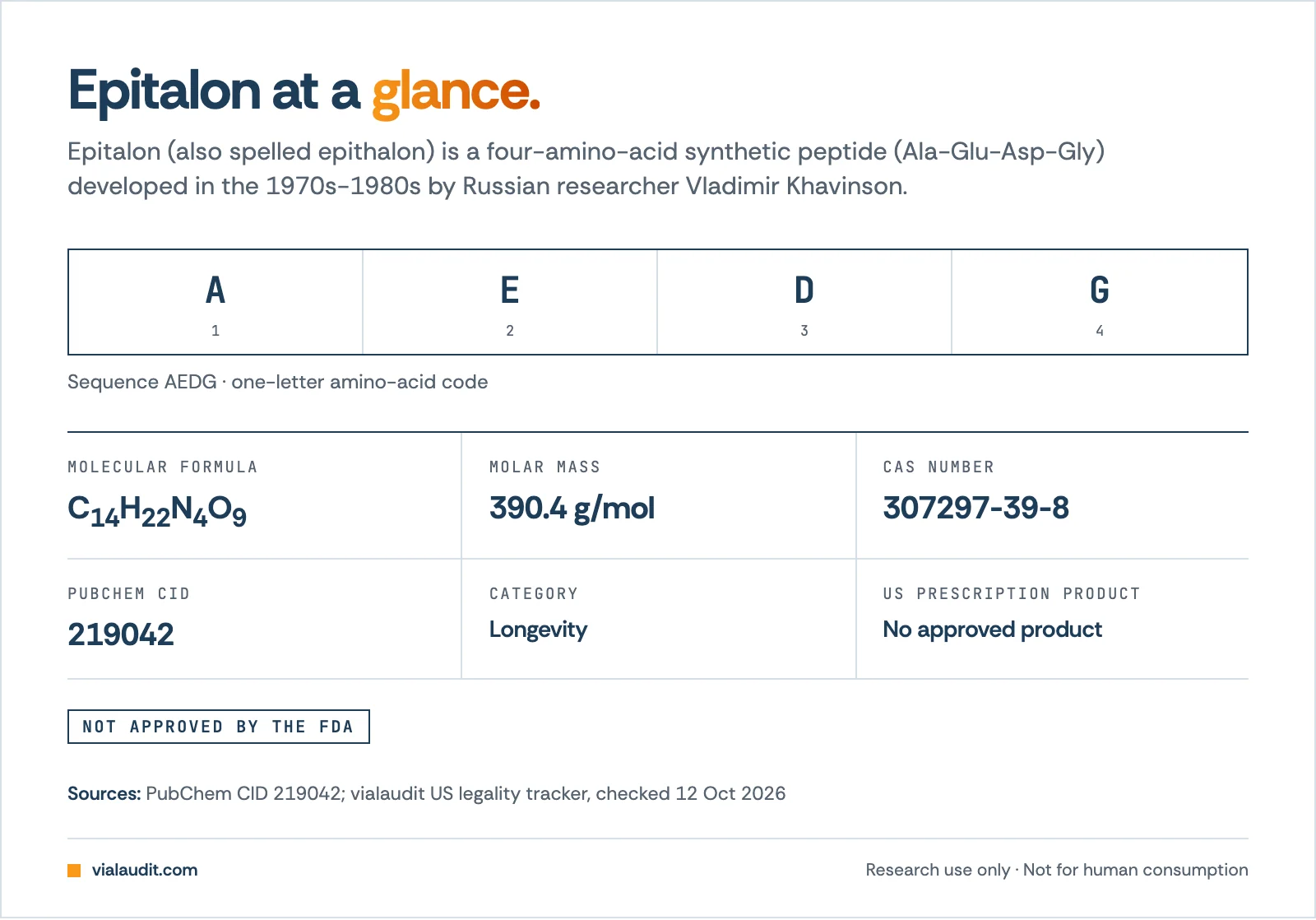
Epitalon (also spelled epithalon) is a four-amino-acid synthetic peptide (Ala-Glu-Asp-Gly) developed in the 1970s-1980s by Russian researcher Vladimir Khavinson. The original research framed it as a synthetic analog of a tetrapeptide isolated from the pineal gland's epithalamin extract. Modern research-protocol interest centers on two claims from the Russian literature: telomerase activation in cell-culture studies, and circadian / melatonin-axis effects in elderly cohorts. The evidence base outside the Russian research tradition is thin, and major Western longevity trials have not yet replicated the headline findings.
Research notes
What epitalon is
Epitalon is a four-amino-acid synthetic peptide (Ala-Glu-Asp-Gly, also written AEDG) developed by Vladimir Khavinson's research group at the St. Petersburg Institute of Bioregulation and Gerontology starting in the 1970s. The original work framed it as the synthetic analog of a tetrapeptide isolated from epithalamin, an extract of the bovine pineal gland.
The compound sits in a specific research tradition — Russian peptide-bioregulator work — that is largely separate from the Western longevity-research mainstream. That separation is important for reading the evidence honestly.
The two headline research claims
Telomerase activation in cell culture. Khavinson-group papers in the early 2000s reported that epitalon induced telomerase activity in human somatic cells, which natively lack telomerase. If reproducible, this would be a meaningful longevity mechanism. The findings have not been independently replicated at the level Western longevity research typically requires.
Circadian and mortality effects in elderly cohorts. Small clinical-cohort studies in St. Petersburg reported that epitalon-treated elderly patients had improved melatonin profiles and lower all-cause mortality at follow-up. These trials were not double-blinded by Western standards and the cohort sizes were small.
What the evidence does NOT show
No major Western longevity research group has replicated the telomerase finding in human trials. The TAME and PEARL trials currently studying metformin and rapamycin in humans do not include epitalon. The compound remains research-protocol material rather than evidence-replicated intervention.
Common research-protocol doses
Russian protocols typically cite 5-10 mg subcutaneous daily for 10-20 day cycles, with 2-3 cycles per year. The cyclic dosing is a feature, not a workaround — the original protocols were designed around the cyclic pattern. These are research-protocol references, not human-use recommendations.
Where buyers source epitalon
Epitalon is widely available through the research-peptide vendor pool. Per-batch purity is typically high because the 4-amino-acid sequence is structurally simple. The compound is generally not available through 503A compounding pharmacies in the US — it sits outside the typical compounded indications.
Is epitalon legal after the July 2026 FDA vote?
No. On 24 July 2026 the FDA Pharmacy Compounding Advisory Committee voted 7-4 with one abstention to recommend epitalon for the 503A Bulks List, nominated for insomnia. Epitalon had already come off the Category 2 do-not-compound list in April 2026.
Neither step legalises compounding. Category 2 removal does not confer eligibility and an advisory recommendation is not a rule, so FDA must either complete notice-and-comment rulemaking or grant interim Category 1 status. Agency review scientists recommended against all seven nominations at that meeting, citing insufficient safety and efficacy data. The full picture is in our FDA peptide vote explainer.
The insomnia nomination is worth noting against the evidence above. The Russian literature on epitalon is built around telomerase activation and circadian and melatonin-axis effects in elderly cohorts. Insomnia is the narrowest clinical claim that evidence base could support, and it is a long way from the longevity framing the compound is sold under.
What the third-party testing shows
Our Kovera mirror holds no epitalon certificates as of 2 August 2026, so we have no lab data of our own on this compound. That absence is itself worth recording. Compounds with a heavy longevity-marketing presence and a thin third-party testing footprint are harder to verify, not easier, and a vendor publishing no independent certificate for epitalon is common rather than exceptional.
Where a vendor does publish one, check it against the issuing lab through our COA verifier rather than trusting a vendor-hosted PDF, and note the date you retrieved it.
Related reading
- Peptides for sleep — what the melatonin studies show next to the other peptides sold for sleep.
- NAD+ peptide page — the other major longevity compound with mixed evidence quality.
- MOTS-c peptide page — mitochondrial-derived peptide with longevity-research interest.
- Klotho peptide page — anti-aging protein with stronger Western-research evidence base.
- FDA peptide vote 2026 - the July PCAC recommendation covering epitalon, and what still stands between it and legal compounding.
- Semax peptide page - the other Russian-tradition peptide backed by the same committee.
- Longevity peptides 2026 overview — the broader cluster epitalon sits in.
What it's researched for
- longevity research
- telomerase activation research
- circadian / pineal research
Where to source it
ALL 7 VENDORS →7 audited vendors stock Epitalon, but the price walk hasn't captured a current listing for it. See all 7 vendors →
Frequently asked about Epitalon
What is epitalon?
Epitalon (also called epithalon or epithalamin) is a tetrapeptide with the sequence Ala-Glu-Asp-Gly, developed by Vladimir Khavinson's research group in Russia starting in the 1970s. It is the synthetic analog of a peptide first isolated from the pineal-gland extract called epithalamin. Research interest centers on telomerase activation and pineal-melatonin signaling.
Why is epitalon studied for longevity?
Two specific findings from the Khavinson group drive the interest. First, cell-culture studies showed that epitalon induced telomerase activity in human somatic cells (which lack significant native telomerase). Second, small human aging-cohort studies in St. Petersburg reported improved circadian rhythms, melatonin profiles, and some mortality endpoints. Both findings have not been replicated by major Western longevity research groups, so the evidence base outside the original Russian work is thin.
What's the typical research-protocol dose?
Russian protocols typically cite 5-10 mg subcutaneous daily for 10-20 day cycles, sometimes 2-3 cycles per year. The cyclic dosing rather than continuous administration is a feature of the original protocols. These are research-protocol references, not human-use recommendations.
How strong is the evidence for epitalon's longevity claims?
Honestly - thin outside the Russian research tradition. The Khavinson group has published cell-culture telomerase data and small clinical-cohort papers showing circadian and mortality endpoints. Major Western longevity research has not replicated the headline findings. Epitalon should be understood as an experimental compound with a specific research tradition, not an evidence-replicated longevity intervention.
How does epitalon compare to other Khavinson peptides?
The Khavinson group developed a family of short peptide bioregulators - epitalon (pineal), thymalin (thymus), prostamax (prostate), and others. All follow the same template: a short peptide derived from a specific organ extract, with research-protocol use focused on that organ system. Epitalon is the most-cited of the family in longevity contexts.
What is the typical purity of research-grade epitalon?
The 4-amino-acid sequence is structurally simple and reliable to synthesize. Janoshik and Kovera Labs testing in our corpus typically show 99%+ purity by HPLC for epitalon from audited vendors. Identity confirmation by mass spectrometry is unambiguous given the small molecular weight.