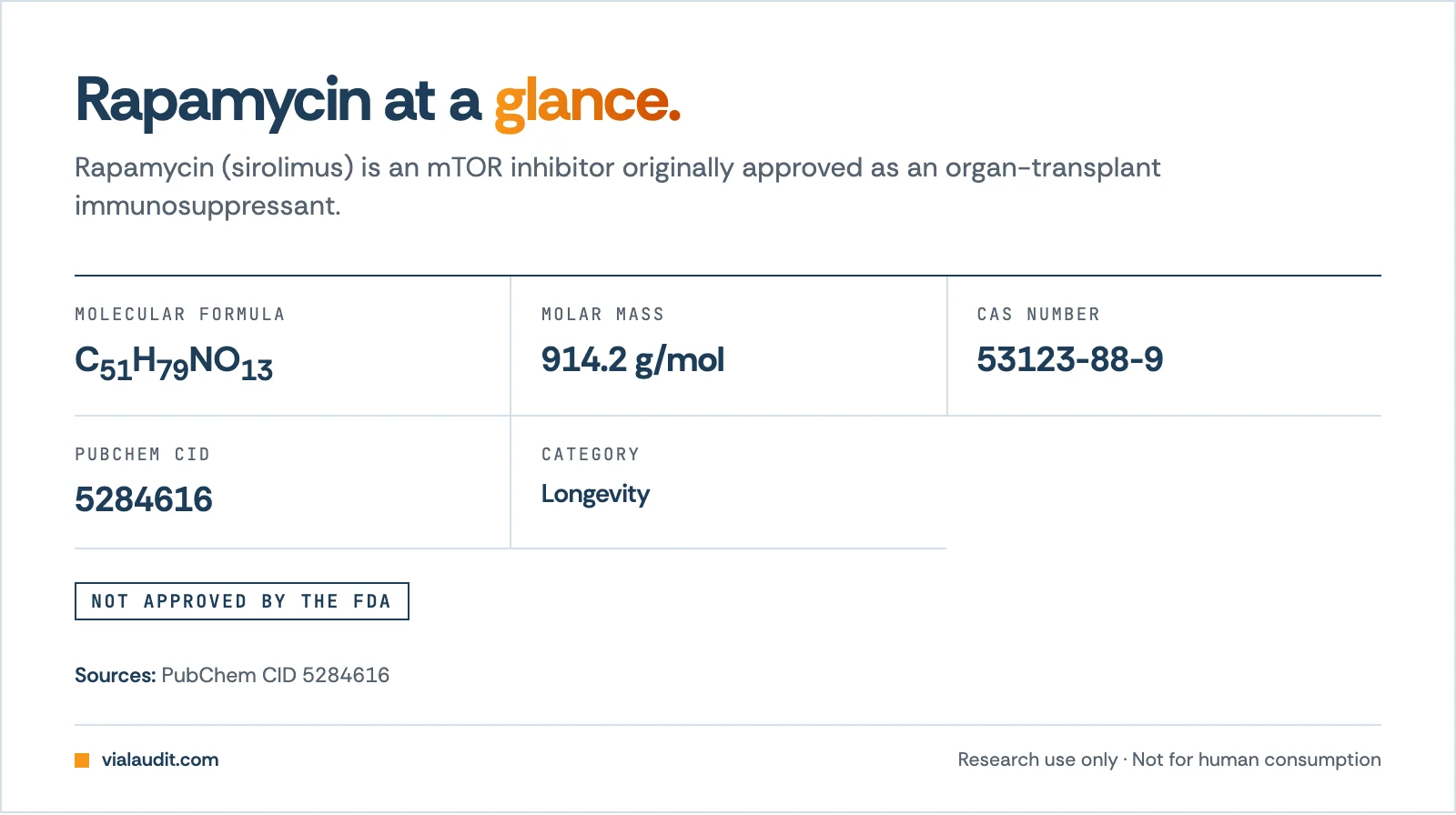
Rapamycin (sirolimus) is an mTOR inhibitor originally approved as an organ-transplant immunosuppressant. It is the only pharmacological intervention that has extended lifespan in every animal model tested — yeast, worms, flies, mice — which is the single strongest cross-species longevity signal in current research. Human off-label use has expanded sharply since 2020, with intermittent weekly dosing protocols (typically 5-10 mg) being studied for healthspan extension. It is FDA-approved for specific indications, not for longevity, and human longevity outcomes data is still developing.
Research notes
What rapamycin is
Rapamycin is a macrolide compound originally isolated from a bacterial species (Streptomyces hygroscopicus) found in Easter Island soil. Bayer marketed it as the immunosuppressant Rapamune starting in 1999, and it has been used for organ-transplant rejection prevention for over 25 years. The longevity-research interest is a separate story driven by the 2009 NIH Interventions Testing Program mouse lifespan trial.
Why the longevity signal matters
The 2009 ITP study fed rapamycin to genetically heterogeneous mice starting at 600 days of age (roughly late-middle-age in mouse years) and saw lifespan extensions of 9-14%. This was the first pharmacological intervention to extend lifespan in mammals starting that late in life. Subsequent ITP trials replicated the effect and showed dose-response curves. mTOR inhibition extends lifespan in yeast, worms, flies, and mice — every model organism it has been tested in.
Common research-protocol doses
Off-label human longevity protocols typically use 5-10 mg orally once per week. The intermittent dosing is chosen specifically to inhibit mTORC1 (the longevity-relevant complex) while allowing mTORC2 (whose chronic inhibition drives many of the side effects) to recover between doses. This is research-protocol reference data, not a treatment recommendation.
Veterinary canine longevity research (Dog Aging Project TRIAD trial) uses 0.13 mg/kg weekly.
Where the research-peptide vendor pool fits
Rapamycin is a small-molecule macrolide rather than a synthetic peptide, but research-peptide vendors increasingly carry it alongside the peptide catalog because the buyer audience overlaps. Sourcing through a research vendor versus a 503A compounding pharmacy versus an off-label prescriber are three structurally different routes — each with its own legal and quality frame. We cover the comparison in rapamycin vs metformin and the broader longevity-vendor landscape in longevity peptides 2026.
Related reading
- Rapamycin vs metformin: the two longevity-drug candidates compared
- Longevity peptides 2026 overview
- NAD+ peptide page — the other major small-molecule longevity intervention
- MOTS-c peptide page — mitochondrial-derived peptide with longevity-research interest
- Klotho peptide page — anti-aging protein with the strongest early-stage longevity biology
What it's researched for
- mTOR inhibition
- longevity research
- immune modulation
Where to source it
ALL 0 VENDORS →No vendors in our audit cycle currently list Rapamycin as a specialty. Cross-reference the leaderboard for vendors that may stock it on request.
Frequently asked about Rapamycin
What is rapamycin?
Rapamycin is a macrolide compound first isolated from Easter Island soil (Rapa Nui — hence the name). It inhibits mTORC1, a central nutrient-sensing kinase complex. The FDA approved sirolimus (the chemical name) in 1999 for kidney-transplant rejection prevention. The longevity-research interest is driven by separate findings starting in 2009 that rapamycin extends mouse lifespan even when started in middle age.
Why is rapamycin studied for longevity?
mTOR inhibition extends lifespan in every model organism it has been tested in. The 2009 ITP (Interventions Testing Program) mouse study showed lifespan extension of 9-14% even when treatment began at 600 days of age. This is the strongest cross-species longevity signal in modern pharmacology and has driven significant off-label interest in human protocols.
Is rapamycin FDA-approved for longevity?
No. Rapamycin is FDA-approved as Rapamune for organ-transplant rejection and as Fyarro for advanced PEComa. Longevity use is off-label. Several human longevity trials are underway — most prominently the Dog Aging Project's TRIAD trial in companion dogs and the PEARL trial in humans — but no longevity indication has yet been approved.
What's the typical research-protocol dose for longevity?
Off-label human longevity protocols typically use 5-10 mg orally once per week, with the weekly cadence chosen to allow mTORC1 inhibition without sustained mTORC2 suppression (sustained mTORC2 inhibition drives the side effects associated with daily transplant dosing). This is research-protocol reference data, not medical guidance.
What are the side effects of rapamycin?
At transplant-indication daily dosing, documented side effects include mouth sores (stomatitis), elevated cholesterol and triglycerides, impaired glucose tolerance, edema, and increased infection risk. Intermittent weekly low-dose protocols studied for longevity reduce but do not eliminate these risks. Long-term data on intermittent protocols is still developing.
How does rapamycin compare to metformin for longevity?
Both are repurposed drugs under longevity investigation, but they target different pathways. Rapamycin directly inhibits mTOR and has stronger model-organism lifespan-extension data. Metformin works through AMPK activation and complex I inhibition and has more accumulated human safety data from decades of diabetes use. The TAME trial is the active human study for metformin's longevity hypothesis. We cover the comparison in detail at [rapamycin vs metformin](/articles/rapamycin-vs-metformin).