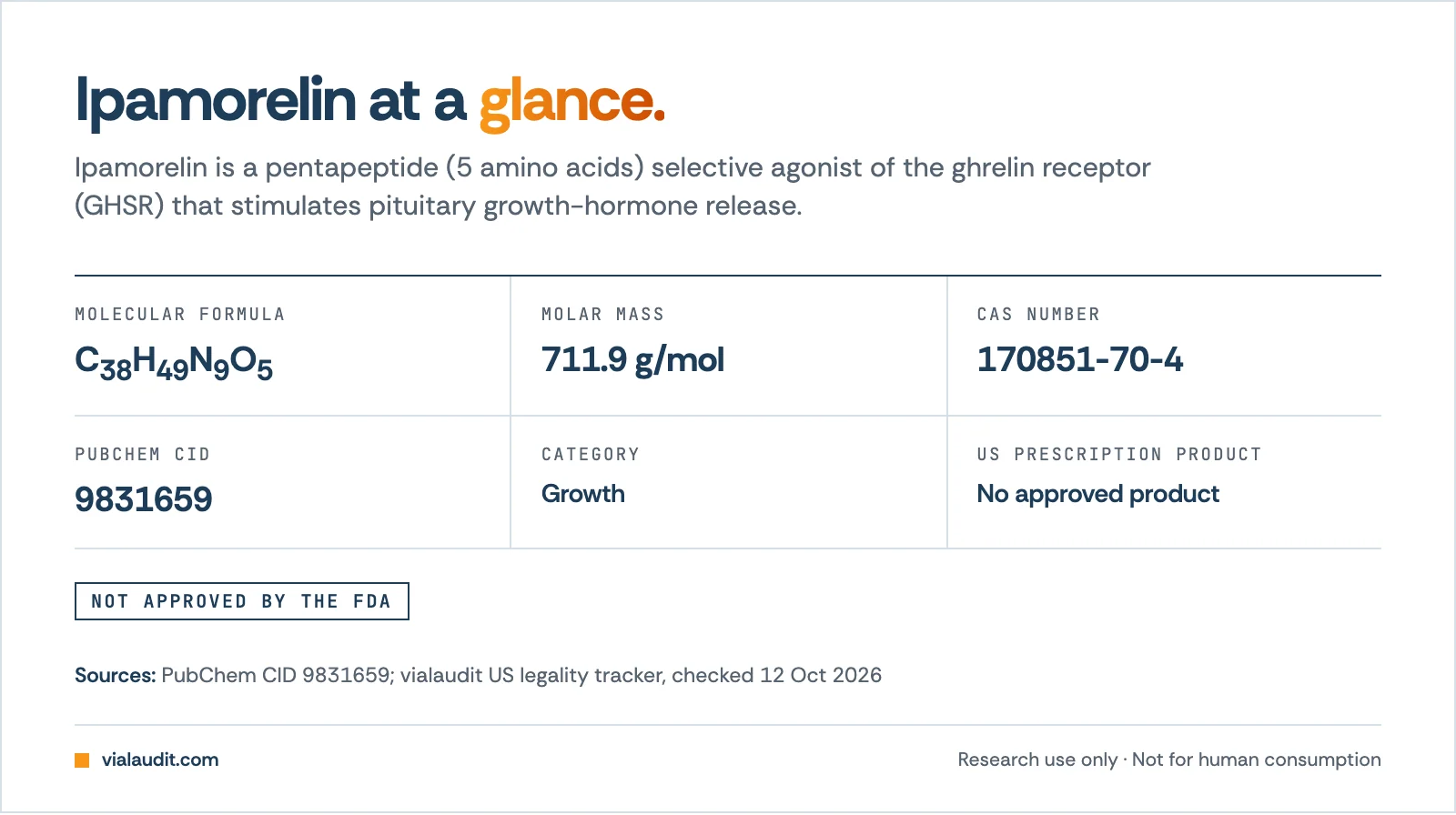
Ipamorelin is a pentapeptide (5 amino acids) selective agonist of the ghrelin receptor (GHSR) that stimulates pituitary growth-hormone release. It is the most-selective ghrelin-receptor compound in the research-peptide pool — unlike older ghrelin agonists (GHRP-6, GHRP-2), it does not significantly elevate prolactin, cortisol, or appetite. This selectivity is why it is the GHSR partner of choice in the CJC-1295 + Ipamorelin stack that dominates GHRH-axis research protocols.
Research notes
What ipamorelin does
Ipamorelin is a five-amino-acid synthetic peptide (Aib-His-D-2-Nal-D-Phe-Lys-NH2) that activates the GHSR (growth-hormone-secretagogue receptor, also called the ghrelin receptor) on pituitary somatotrophs. Receptor activation triggers GH release through a pathway parallel to GHRH.
The selling point is selectivity. Older ghrelin agonists (GHRP-6, GHRP-2) raise prolactin, cortisol, and appetite alongside GH. Ipamorelin produces GH release without meaningful prolactin or cortisol elevation, which is why it replaced the older compounds in research-protocol use.
The CJC-1295 + Ipamorelin stack
Almost every research protocol that uses ipamorelin also uses CJC-1295. The two activate different receptors that synergize for GH release. The most-cited dosing pattern is 100-200 mcg CJC-1295 no-DAC + 200-300 mcg ipamorelin in a single subcutaneous injection, dosed nightly.
The synergy is meaningful — co-administration produces approximately 2-5x greater peak GH compared with either compound alone at the same doses. The mechanism is complementary receptor activation rather than additive same-pathway signaling.
See CJC-1295 vs Ipamorelin for the comparison framing buyers usually want.
How ipamorelin compares to other GHSR ligands
| GHSR ligand | Selectivity | Notes |
|---|---|---|
| GHRP-6 | Low | Raises appetite, prolactin, cortisol |
| GHRP-2 | Medium-low | Lower appetite effect than GHRP-6 but still raises prolactin/cortisol |
| Ipamorelin | High | Clean GH release; minimal prolactin/cortisol/appetite effects |
| Hexarelin | Medium | Higher peak GH but desensitization risk on chronic use |
Where buyers source ipamorelin
Ipamorelin is one of the most-stocked GHSR ligands in both the research-peptide channel and via 503A compounding pharmacies for specific HRT-adjacent protocols. Vendor coverage spans every major audited brand on the site. Per-batch purity is typically very consistent.
Related reading
- Peptides for sleep — ipamorelin has no sleep study; what ghrelin and MK-677 research does and does not imply.
- CJC-1295 vs Ipamorelin — the comparison most buyers actually want.
- CJC-1295 peptide page — the GHRH analog ipamorelin is almost always paired with.
- Sermorelin peptide page — alternative GHRH analog with a shorter half-life.
- Tesamorelin peptide page — FDA-approved GHRH analog.
- Longevity peptides 2026 overview
What it's researched for
- growth hormone axis support
- longevity research
- sleep and recovery
Where to source it
ALL 10 VENDORS →10 audited vendors stock Ipamorelin, but the price walk hasn't captured a current listing for it. See all 10 vendors →
Frequently asked about Ipamorelin
What is ipamorelin?
Ipamorelin is a five-amino-acid synthetic peptide that activates the ghrelin receptor (GHSR) on pituitary somatotrophs. The receptor activation stimulates growth hormone release through a pathway parallel to and synergistic with GHRH. It was developed in the 1990s as a more selective alternative to earlier ghrelin agonists.
How is ipamorelin different from GHRP-6 and GHRP-2?
All three are GHSR agonists, but GHRP-6 and GHRP-2 are non-selective — they elevate prolactin, cortisol, and appetite alongside GH release. Ipamorelin is selective enough that GH release happens without meaningful prolactin or cortisol elevation. The selectivity is why ipamorelin replaced GHRP-2 and GHRP-6 as the GHSR ligand of choice in modern research protocols.
Why is ipamorelin paired with CJC-1295?
The two activate different receptors that synergize. CJC-1295 binds the GHRH receptor; ipamorelin binds the GHSR (ghrelin receptor). Co-activation produces greater GH release than either alone. The CJC-1295 no-DAC + Ipamorelin combination is the most-cited stack pattern in GH-axis research protocols. We cover the comparison in detail at [CJC-1295 vs Ipamorelin](/articles/cjc-1295-vs-ipamorelin).
What doses are used in ipamorelin research?
Research protocols typically cite 200-300 mcg subcutaneous nightly, paired with 100-200 mcg CJC-1295 no-DAC in the same injection. The bedtime timing aligns with the natural overnight GH pulse. These are research-protocol references, not human-use recommendations.
Is ipamorelin FDA-approved?
No. Ipamorelin reached Phase 2 trials for post-operative ileus in the 2010s but was not pursued to FDA approval. There is no current approved indication. Research-grade ipamorelin sold by peptide vendors is the same molecule but is not labeled or distributed for human use.
What is the typical purity of research-grade ipamorelin?
Janoshik and Kovera Labs testing in our corpus typically show 99%+ purity by HPLC for ipamorelin from audited vendors. The short 5-amino-acid sequence is structurally simple and reliable to synthesize, so lot-to-lot purity variance is low.