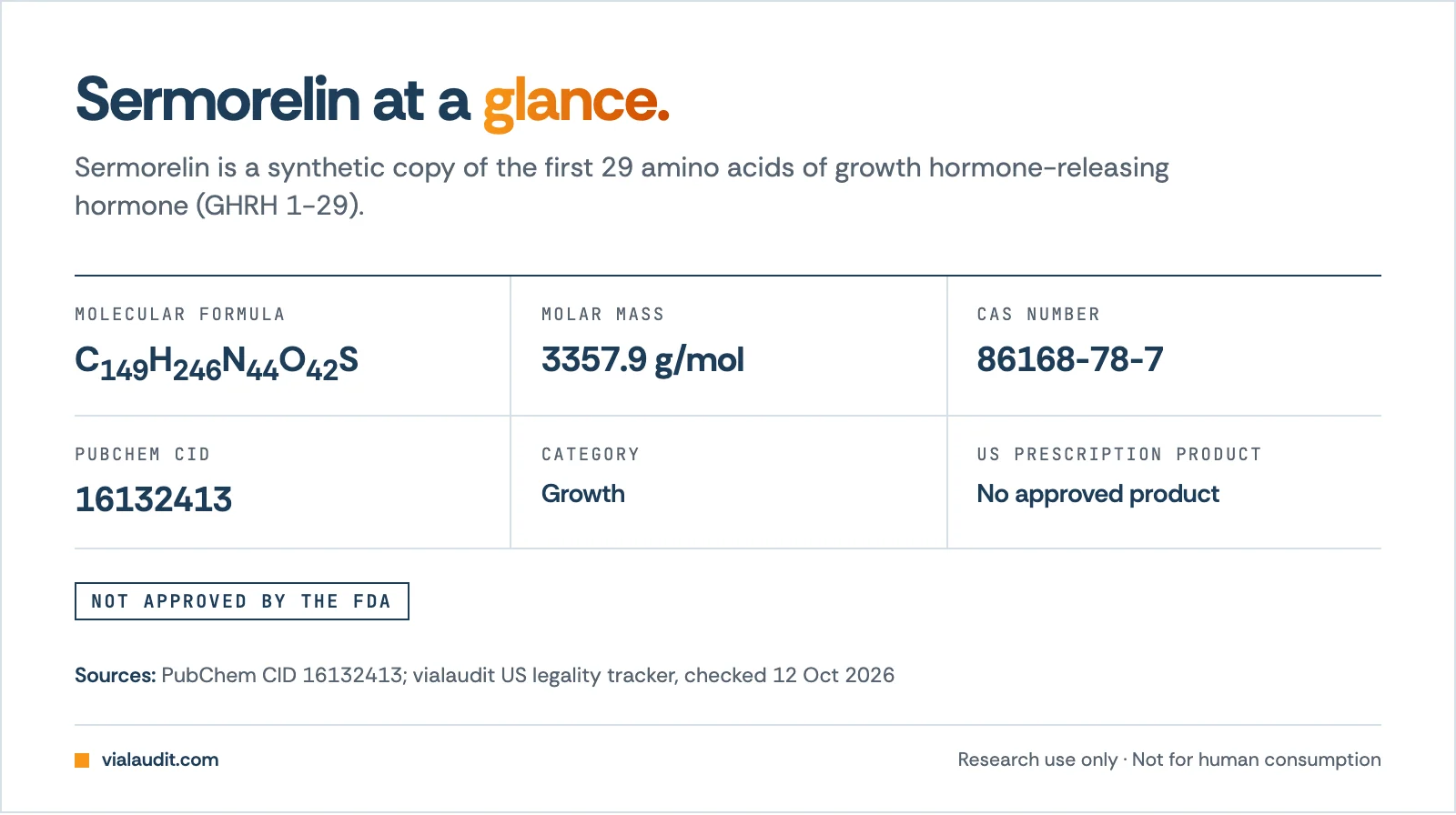
Sermorelin is a synthetic copy of the first 29 amino acids of growth hormone-releasing hormone (GHRH 1-29). It prompts the pituitary to release its own growth hormone in pulses, rather than supplying growth hormone directly. FDA approved it as Geref in 1990 (a diagnostic test) and 1997 (for children with GH deficiency). The maker discontinued both in 2008 and FDA withdrew approval effective 18 June 2009, later ruling the exit was not for safety or effectiveness reasons. No approved product exists today; US pharmacies compound it under section 503A. Of 20 sermorelin vials in our lab mirrors, 19 tested above 98.7% purity and one came back at 80.6%.
Research notes
Sermorelin is GHRH 1-29, the active fragment of the hormone that tells your pituitary to release growth hormone. FDA approved it as Geref, and the maker stopped selling it in 2008. Today patients get it from compounding pharmacies and buyers get it from research-peptide vendors. Of 20 vials in our lab mirrors, 19 tested above 98.7% purity and one came back at 80.6%.
Why is sermorelin in the news?
One person's results tell you nothing about a vial you buy. His other peptide has its own page: BPC-157.
What is sermorelin, and how does it work?
Sermorelin is the first 29 amino acids of human GHRH, the segment that binds the GHRH receptor on pituitary somatotrophs. Receptor binding triggers cAMP signaling and downstream growth-hormone release. Your body clears sermorelin in about 12 minutes, so the effect comes from the pulse of your own GH that the injection produces, not from sermorelin lingering in the blood.
Working through the pituitary cuts both ways:
- Natural pattern kept. Your pituitary still releases GH in pulses, peaking overnight.
- Smaller effect. IGF-1 still feeds back on the pituitary and caps the response, a brake that injected HGH skips. In a 1993 trial in 60 children, GHRH produced less growth than GH itself.
Is sermorelin FDA approved?
Not today. FDA approved it twice and withdrew both approvals in 2009 at the maker's request:
| Date | Event | Source |
|---|---|---|
| 28 Dec 1990 | Geref 0.05 mg approved (NDA 19-863) to test whether the pituitary can secrete GH | Federal Register, 2013 |
| 26 Sep 1997 | Geref 0.5 and 1.0 mg approved (NDA 20-443) for idiopathic GH deficiency in children with growth failure | same |
| 11 Jul and 2 Dec 2008 | EMD Serono tells FDA both products are being discontinued | same |
| 19 May 2009 | FDA announces withdrawal of both approvals at EMD Serono's request, effective 18 June 2009 | 74 FR 23407 |
| 4 Mar 2013 | FDA determines neither product was withdrawn for safety or effectiveness reasons | 78 FR 14095 |
In August 2008 EMD Serono said it was discontinuing Geref Diagnostic because the active ingredient was no longer being manufactured. The 2013 notice means a company could file a generic application that refers back to Geref. As of 9 October 2026, openFDA listed only the two original Geref applications, both discontinued.
Can pharmacies legally compound sermorelin?
Under section 503A, a pharmacy may compound from a bulk substance that has a USP monograph, is a component of an FDA-approved drug, or sits on FDA's 503A Bulks List. A 16 March 2026 analysis by the law firm Goldsand & Friedberg reads sermorelin as falling under the second route, because Geref was approved and left the market for commercial reasons. We found no FDA statement addressing sermorelin by name.
That reading would explain why sermorelin did not come up at the July 2026 advisory committee meeting covered in our FDA peptide vote explainer. It does not appear in any of the three categories on FDA's 503A nominations list, updated 14 May 2026. BPC-157 and the other peptides at that meeting needed a Bulks List decision because none was ever approved.
Compounded sermorelin is still not an FDA-approved drug. FDA does not review it for safety, effectiveness or quality before a pharmacy dispenses it. Research-grade vials sold online are a separate product, labelled for laboratory use only.
What does the evidence show?
| Study | Who | What they took | Result |
|---|---|---|---|
| Thorner et al., JCEM 1996 | 110 GH-deficient children, open label | 30 mcg/kg nightly for up to a year | Height velocity rose from 4.1 to 8.0 cm/yr at 6 months and 7.2 cm/yr at 12 months |
| Chen et al., Acta Paediatr 1993 | 60 GH-deficient children, randomized | GHRH 30 or 60 mcg/kg/day by continuous infusion vs GH, 6 months | 9.2 and 9.3 cm/yr on GHRH vs 14.6 on GH; 39 of 40 GHRH patients developed GHRH antibodies |
| Corpas et al., JCEM 1992 | 10 healthy older men vs 9 young men | 0.5 or 1 mg twice daily, 14 days each | The 1 mg dose brought GH and IGF-1 up to young-adult levels |
| Vittone et al., Metabolism 1997 | 11 healthy men aged 64-76 | 2 mg nightly, 6 weeks | Nocturnal GH rose; IGF-1, weight and body composition did not change; 2 of 6 strength measures improved |
| Walker, Clin Interv Aging 2006 | Two-page editorial | n/a | Asks whether sermorelin suits adult-onset GH insufficiency; no new trial data |
The strongest evidence is pediatric, from the indication FDA approved. The adult studies are small and short, and mostly measured hormone levels rather than outcomes you would notice. The Vittone authors concluded that single nightly doses were "less effective than multiple daily doses" at producing GH- and IGF-1-mediated effects. No trial has tested sermorelin for muscle gain in healthy young adults.
What doses did the clinical studies use?
The protocols are in the table above: the Geref pediatric label, and two small adult studies. These describe what studies did, not recommendations. The dose ranges repeated on research-peptide sites do not come from any of these trials.
How pure is the sermorelin on the market?
Mostly clean, with one bad result. Our mirrors of third-party certificates hold 20 sermorelin records: 18 from Kovera Labs and 2 from Janoshik.
Across the 18 Kovera certificates, covering 15 vendors, tested between 20 February and 30 May 2026, from our snapshot of 1 August 2026:
| Measure | Value |
|---|---|
| Records | 18 |
| Distinct vendors | 15 |
| Median purity | 99.96% |
| Lowest purity | 98.76% |
| Identity confirmed | 18 of 18 |
| Median fill vs label | 113.6% |
| Vials under labelled content | 1 (9.72 mg against 10 mg) |
| Endotoxin reported | 11, all below 0.10 EU/mL |
Most vials held more than their label said, up to 128.5% of it. Overfill is common in this market. It says nothing about safety, only that the label understates the amount inside.
The two Janoshik reports split. Test 96847, from January 2026, measured 9.66 mg at 99.72% purity. Test 155103, dated 14 May 2026 for a client listed as "longevity pro's," found sermorelin at 4.58 mg with 80.58% purity. The report gives no labelled amount and no pass or fail verdict; its only comment is that the sample "was tested twice." At 80.58%, roughly a fifth of the HPLC signal came from something other than sermorelin, the lowest result in our sermorelin records.
Run any certificate through our COA verifier, which checks it against the issuing lab's own record. Our Kovera vendor leaderboard shows how individual vendors score across compounds.
How does sermorelin compare with tesamorelin and CJC-1295?
All three act on the GHRH receptor. Tesamorelin adds a chemical cap that slows breakdown, and it is the only one with a current FDA approval (Egrifta, for HIV-associated abdominal fat). CJC-1295 with DAC binds albumin and lasts days rather than minutes. We compare the first two in tesamorelin vs sermorelin. The GHRH and ghrelin-agonist stack appears in CJC-1295 vs ipamorelin.
Related reading
- Peptides for sleep: the GHRH sleep-lab studies behind sermorelin's sleep claims, and what they do not show.
- Tesamorelin vs sermorelin: head-to-head between the two GHRH analogs.
- CJC-1295 vs ipamorelin: the stack most often compared with sermorelin.
- CJC-1295: long-acting GHRH analog.
- Tesamorelin: the FDA-approved GHRH analog.
- BPC-157: the other peptide Pete Davidson named.
- FDA peptide vote 2026: what the July advisory vote did and did not change.
- Longevity peptides 2026: the broader cluster sermorelin sits in.
What it's researched for
- growth hormone axis support
- longevity research
- sleep and recovery
Where to source it
ALL 4 VENDORS →4 audited vendors stock Sermorelin, but the price walk hasn't captured a current listing for it. See all 4 vendors →
Frequently asked about Sermorelin
What is sermorelin?
Sermorelin is a synthetic analog of the first 29 amino acids of human GHRH (growth hormone-releasing hormone). It binds the GHRH receptor on the pituitary and triggers the body's own growth-hormone release. Because it works through that pathway, it preserves the pulsed, mostly overnight pattern of GH secretion instead of producing a flat exogenous-HGH signal.
Is sermorelin FDA approved?
Not today. FDA approved sermorelin as Geref twice: on 28 December 1990 as a pituitary diagnostic test, and on 26 September 1997 for children with idiopathic GH deficiency. EMD Serono discontinued both in 2008 and FDA withdrew the approvals effective 18 June 2009. In 2013 FDA ruled neither was withdrawn for safety or effectiveness reasons.
Is sermorelin legal?
In the US, licensed pharmacies compound sermorelin against a prescription under section 503A. One compounding law firm ties that to Geref, an FDA-approved drug withdrawn for commercial reasons; FDA has not addressed sermorelin by name. It is not on FDA's 503A nominations list (updated 14 May 2026). Research-grade vials are labelled not for human use.
How is sermorelin different from HGH?
HGH (somatropin) is growth hormone itself, so injecting it bypasses the pituitary and raises levels directly. Sermorelin makes the pituitary release its own GH, so feedback from IGF-1 still limits the response. The trade-off is a smaller absolute rise. In a 1993 pediatric trial that gave GHRH by continuous infusion, children grew 9.2 cm a year against 14.6 cm on GH.
What does sermorelin do for adults?
Small studies in older men show it raises GH and IGF-1. Ten men on 1 mg twice daily for 14 days reached IGF-1 levels similar to young men in a 1992 NIH study. Eleven men on 2 mg nightly for six weeks had higher nocturnal GH but no change in IGF-1, weight or body composition. No large adult trial exists.
Did Pete Davidson use sermorelin?
Variety reported on 30 September 2026 that he took sermorelin and BPC-157 while training to add 15 pounds of muscle for the film "How to Rob a Bank." He told Variety, "They work." The interview does not say where the peptides came from or whether a clinician prescribed them.
How pure is research-grade sermorelin?
Across 18 Kovera Labs certificates from 15 vendors, February to May 2026, median purity was 99.96% and every vial passed identity testing. Two Janoshik reports add one vial at 99.72% and one at 80.58%, far below the 95% line we use to flag a result. Check any certificate on the lab's own site.