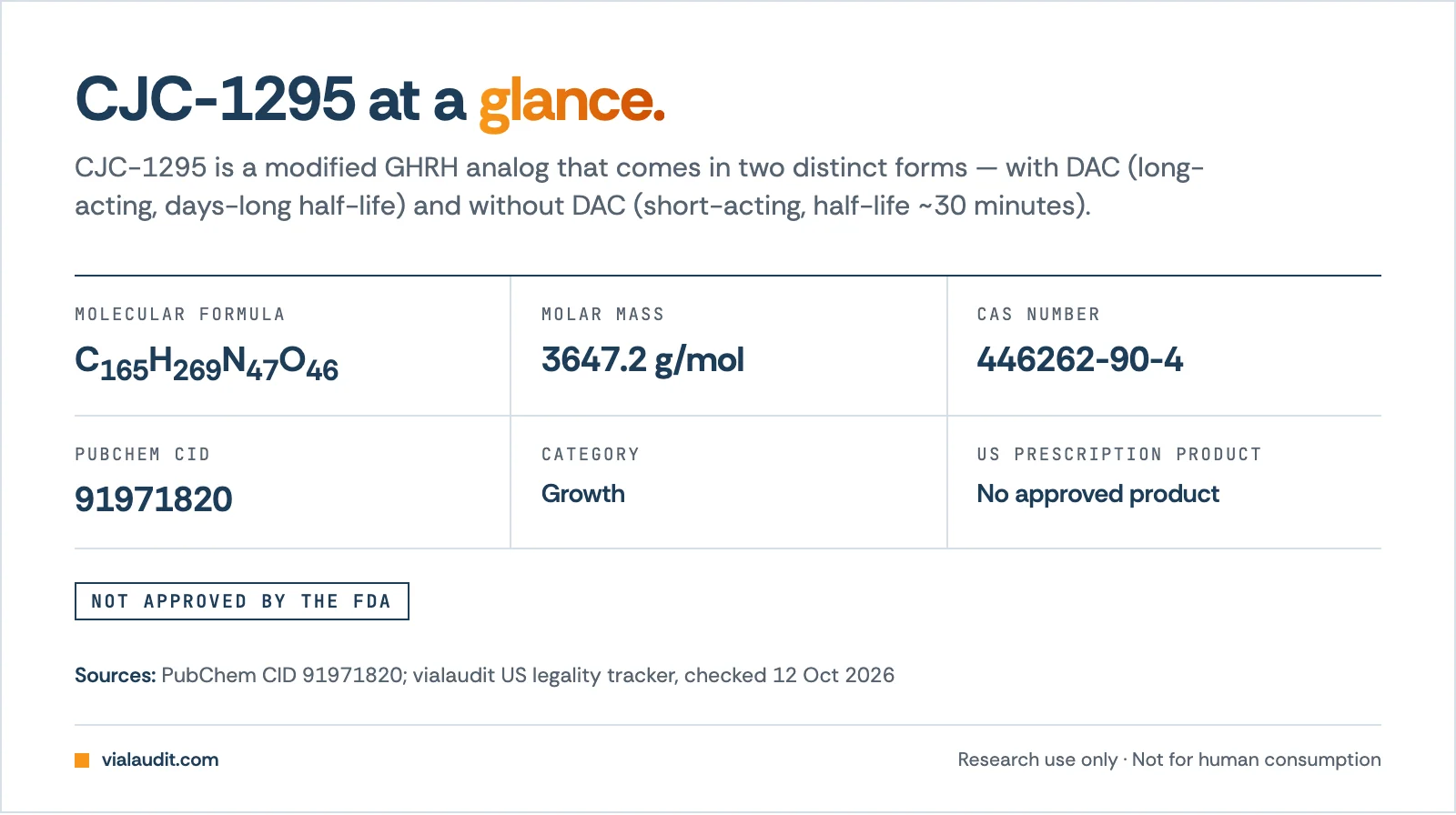
CJC-1295 is a modified GHRH analog that comes in two distinct forms — with DAC (long-acting, days-long half-life) and without DAC (short-acting, half-life ~30 minutes). The DAC variant binds circulating albumin and produces sustained GH and IGF-1 elevation; the no-DAC variant (also called Modified GRF 1-29) produces a sharp pulse similar to sermorelin. Research protocols pair CJC-1295 with ipamorelin almost universally — the two work through complementary pathways (GHRH receptor for CJC-1295, ghrelin receptor for ipamorelin) and produce a synergistic GH-release signal.
Research notes
CJC-1295 vs Modified GRF 1-29 — same backbone, different applications
The CJC-1295 family has two distinct forms that buyers often conflate.
CJC-1295 DAC is the long-acting version. The DAC (drug-affinity-complex) modification is a maleimide group that covalently bonds to circulating albumin. This extends the half-life from minutes to 6-10 days and produces sustained GH and IGF-1 elevation rather than a sharp pulse.
CJC-1295 no-DAC (also called Modified GRF 1-29) keeps the enzymatic-stability modifications but removes the albumin-binding group. Half-life is ~30 minutes. The effect is a pulse-and-clear pattern similar to sermorelin but with slightly better in-vivo stability.
Selecting between them depends on whether sustained or pulsatile GH signaling is the research-protocol goal.
Why CJC-1295 is paired with ipamorelin
Almost every research protocol that uses CJC-1295 also uses ipamorelin. The two compounds activate different receptors that synergize for GH release. CJC-1295 binds the GHRH receptor (R1). Ipamorelin binds the ghrelin receptor (GHSR). Activating both produces greater GH release than either alone, and ipamorelin's GHSR selectivity avoids the prolactin, cortisol, and appetite-stimulation effects of older ghrelin agonists.
The most-cited dosing pattern in the literature is 100-200 mcg CJC-1295 no-DAC + 200-300 mcg ipamorelin in a single subcutaneous injection, dosed nightly to align with natural GH pulsatility.
How CJC-1295 compares across the GHRH-analog ladder
| GHRH analog | Half-life | Typical use case |
|---|---|---|
| Sermorelin | ~12 min | Pulsatile, low-burden |
| Modified GRF 1-29 (CJC no-DAC) | ~30 min | Pulsatile with better stability |
| CJC-1295 DAC | ~6-10 days | Sustained GH/IGF-1 elevation |
| Tesamorelin | ~26 min | FDA-approved for HIV lipodystrophy |
See Tesamorelin vs Sermorelin and CJC-1295 vs Ipamorelin for deeper comparisons.
Related reading
- Peptides for sleep — the GHRH sleep evidence CJC-1295's sleep claims borrow from.
- CJC-1295 vs Ipamorelin — the most-paired stack in research-peptide protocols.
- Ipamorelin peptide page — the ghrelin-receptor agonist almost always co-administered.
- Sermorelin peptide page — the shorter-acting parent GHRH analog.
- Tesamorelin peptide page — the FDA-approved GHRH analog with a different research-protocol shape.
- Longevity peptides 2026 overview
What it's researched for
- growth hormone axis support
- longevity research
- body composition research
Where to source it
ALL 9 VENDORS →RANKED BY COMPOSITE SCORE · PRICES ARE SNAPSHOTS FROM THE PRICE INDEX · PER-MG IS A WITHIN-COMPOUND COMPARATOR
Frequently asked about CJC-1295
What is CJC-1295?
CJC-1295 is a synthetic GHRH analog with structural modifications that protect against enzymatic degradation. It exists in two forms — with DAC (drug-affinity-complex, a maleimide moiety that covalently bonds to albumin and extends half-life to days) and without DAC (Modified GRF 1-29, which preserves the modifications but not the albumin-binding group).
What's the difference between CJC-1295 DAC and CJC-1295 no-DAC?
The DAC modification binds circulating albumin, extending CJC-1295's half-life from ~30 minutes to 6-10 days. CJC-1295 DAC produces sustained GH and IGF-1 elevation. CJC-1295 no-DAC (Modified GRF 1-29) produces a sharp GH pulse and clears quickly, preserving the pulsatile pattern of natural GH secretion. Research protocol selection between the two depends on whether sustained or pulsatile signaling is the goal.
Why is CJC-1295 paired with ipamorelin?
The two compounds activate different receptors that synergize. CJC-1295 binds the GHRH receptor; ipamorelin binds the ghrelin receptor (GHSR). Co-activation of both pathways produces greater GH release than either alone, and ipamorelin's selectivity for GHSR (without the prolactin / cortisol / appetite effects of older ghrelin agonists) makes it the preferred GHSR partner. The CJC-1295 + Ipamorelin stack is one of the most-studied research-protocol combinations.
How does CJC-1295 compare to sermorelin?
Sermorelin is GHRH 1-29 with minimal modification — half-life ~12 minutes, single pulse per injection. CJC-1295 no-DAC is also based on the GHRH 1-29 segment but with enzymatic-stability modifications and a slightly longer half-life. CJC-1295 DAC is the same modified backbone plus the albumin-binding group that extends action to days. Sermorelin sits at one end of the half-life spectrum, CJC-1295 DAC at the other.
What doses are used in CJC-1295 research?
CJC-1295 DAC is typically dosed at 100-300 mcg weekly. CJC-1295 no-DAC is dosed at 100-200 mcg daily, often paired with 200-300 mcg ipamorelin in the same injection. These are research-protocol references, not human-use recommendations.
What is the typical purity of research-grade CJC-1295?
Janoshik and Kovera Labs testing in our corpus typically show 99%+ purity by HPLC for CJC-1295 (both DAC and no-DAC) from audited vendors. The DAC variant is somewhat harder to synthesize cleanly than the no-DAC, so lot-to-lot purity variance is slightly higher than for shorter peptides.