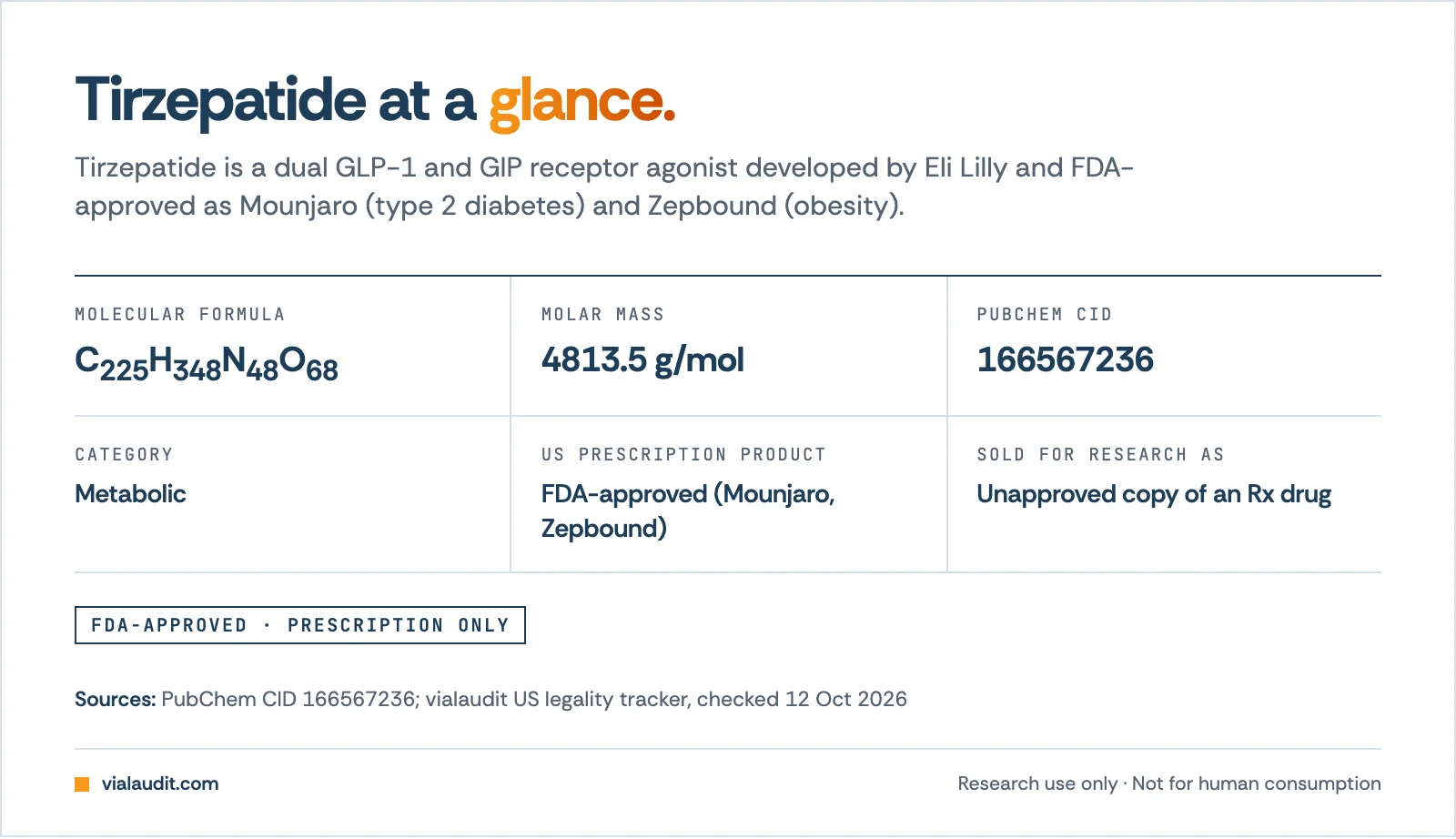
Tirzepatide is a dual GLP-1 and GIP receptor agonist developed by Eli Lilly and FDA-approved as Mounjaro (type 2 diabetes) and Zepbound (obesity). The dual mechanism produces greater weight-loss outcomes than GLP-1-only drugs in head-to-head trials. Research-grade tirzepatide sold by peptide vendors is the same molecule but is not pharmaceutical-grade.
Research notes
How does Tirzepatide work?
Tirzepatide hits two incretin receptors: GLP-1 and GIP. The dual agonism produces a larger weight-loss and glycemic effect than GLP-1 monotherapy at comparable doses. Marketed as Mounjaro for type 2 diabetes and Zepbound for obesity by Eli Lilly.
What doses are used in research?
Standard escalation schedule starts at 2.5 mg weekly, increasing every four weeks through 5, 7.5, 10, 12.5, and 15 mg. The Surmount trials used this schedule with optimal weight-loss outcomes at the 10–15 mg range.
What the lab record shows
Our purity study pools 2,087 public lab results from Kovera Labs, Janoshik and four vendor-published certificate sets, with duplicate test numbers counted once. Tirzepatide is the second-largest compound in it, behind retatrutide.
| Measure | Tirzepatide |
|---|---|
| Results | 187, from 91 clients |
| Median HPLC purity | 99.88% (184 results; lowest 98.38%) |
| Median content vs label | 111.1% (176 results) |
| Under 90% of label | 0 of 176 |
| Under 95% of label | 1 of 176 |
| More than 110% of label | 99 of 176 (56.3%) |
| Failed identity | 1 |
The identity failure is Kovera certificate KVR-2026-17CDBE, analysed 20 May 2026: labelled tirzepatide 15 mg, measured 0 mg of the labelled compound, graded a fail.
Vendors choose which batches to send to a lab and which certificates to publish, so the unpublished population is likely worse. Purity alone cannot catch a wrong molecule; check that a certificate reports a mass-spec identity result as well as HPLC purity. You can open any Kovera certificate by report number in our Kovera index, and Janoshik reports in our Janoshik index. For tirzepatide and retatrutide reports from Janoshik specifically, see what Janoshik's GLP-1 results show.
Which vendors carry Tirzepatide?
Tirzepatide is the most-stocked compound across the audited vendor pool — every major research vendor lists it, which makes it the natural starting point for cross-vendor purity comparisons.
What it's researched for
- weight loss
- type 2 diabetes
Where to source it
ALL 11 VENDORS →RANKED BY COMPOSITE SCORE · PRICES ARE SNAPSHOTS FROM THE PRICE INDEX · PER-MG IS A WITHIN-COMPOUND COMPARATOR
Frequently asked about Tirzepatide
What is tirzepatide?
Tirzepatide is a synthetic peptide that activates two hormone receptors simultaneously: GLP-1 (glucagon-like peptide-1) and GIP (glucose-dependent insulinotropic polypeptide). It was developed by Eli Lilly and is the first approved dual incretin agonist.
How is tirzepatide different from semaglutide?
Semaglutide acts only at the GLP-1 receptor. Tirzepatide adds GIP-receptor activation, which in head-to-head trials (SURPASS, SURMOUNT) has produced greater weight-loss and HbA1c-reduction outcomes than semaglutide at comparable doses. The trade-off is a slightly different gastrointestinal side-effect profile.
What's the difference between Mounjaro and Zepbound?
Both are tirzepatide. Mounjaro is FDA-approved for type 2 diabetes. Zepbound is FDA-approved for obesity. The molecule, dosing schedule, and titration ladder are the same; the labeling differs by approved indication.
What doses are used in tirzepatide research?
Published research most often references the FDA-approved titration ladder: 2.5 → 5 → 7.5 → 10 → 12.5 → 15 mg weekly subcutaneous. The half-life is approximately 5 days. Doses cited here are research-protocol references, not human-use recommendations.
What is the typical purity of research-grade tirzepatide?
In the 2,087-result lab record behind our purity study (Kovera, Janoshik and four vendor-published sets, duplicates counted once), tirzepatide has 187 results from 91 clients. The median HPLC purity across 184 results that report one is 99.88%, and the lowest is 98.38%. None of the 176 results with a measured content held under 90% of label; the median was 111.1%. One Kovera certificate failed identity. These are results vendors chose to publish, not a random sample.